You do pay VRT on a car imported from Japan — and because Japan is outside the EU, you also pay customs duty (10%) and VAT (23%) before VRT even enters the picture. There is no special Japan rate and no shortcut around the order in which these charges land.
For an Irish buyer, the anxiety usually comes from not knowing how the taxes stack up. The good news is that the process is entirely predictable once you understand the sequence: customs duty and VAT are settled when the car arrives, then VRT is charged on the Open Market Selling Price (OMSP) plus the NOx levy when you register it. Revenue (the Office of the Revenue Commissioners) and ROS are the final authority on every figure.
Do you pay VRT on a car imported from Japan?
You pay VRT on a Japanese import exactly like any other car registered in Ireland — there is no special Japan rate and no exemption for importing from outside the EU. The same Category A rules that apply to a UK import or a local purchase apply here.
VRT is calculated on the OMSP, which is Revenue's own valuation of the car, not the price you paid at auction. The Category A charge is a percentage of that OMSP based on the car's CO2 band, and the NOx levy is added on top:
VRT = OMSP × CO2 band + NOx levy
So two identical cars bought for very different prices can attract the same VRT, because Revenue values them the same way. That is why estimating against the OMSP — rather than your purchase price — is the only reliable approach.
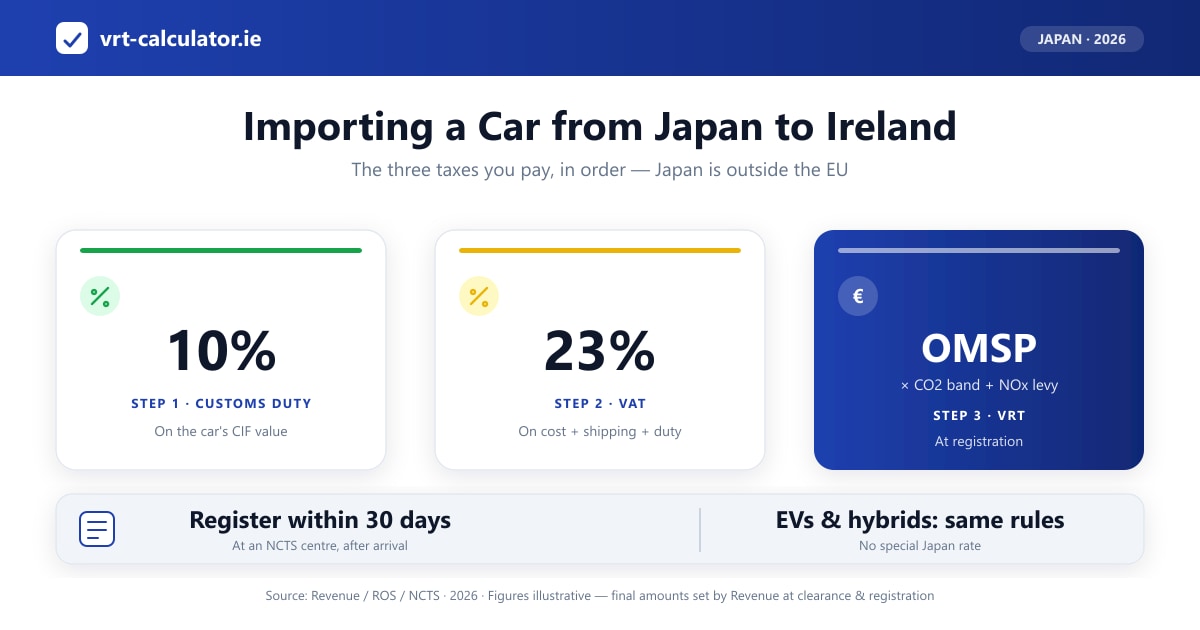
Customs duty and VAT: the extra cost of a non-EU import
Because Japan is outside the EU, a Japanese import attracts customs duty of 10% and VAT at the Irish standard rate of 23% — both paid when the car clears customs, before you ever get to VRT. This is the part that catches buyers who are used to UK or EU purchases off guard.
The order the charges are applied
The charges are applied in a fixed sequence, and each one is calculated on a different base. Getting the order right is what makes the final bill predictable:
| Step | Charge | Calculated on | Rate |
|---|---|---|---|
| 1 | Customs duty | Cost + shipping/insurance (CIF value) | 10% |
| 2 | VAT | Cost + shipping + customs duty | 23% |
| 3 | VRT | OMSP (Revenue's valuation) | CO2 band % + NOx levy |
Because VAT is layered on top of the duty, it is charged on a larger amount than the car alone — a detail that materially changes the running total.
Why VAT lands at 23%
VAT on a car imported from Japan is charged at Ireland's standard rate of 23%, applied to the cost of the car plus shipping plus the customs duty (Revenue, 2026). It is not 21%, and it is not charged only on the purchase price.
One related rule is worth knowing: under the new means of transport rules, VAT is always due if the car is less than 6 months old or has travelled under 6,000 km (Revenue), regardless of where it came from.
How VRT is calculated on a Japanese import
VRT on a Japanese import is charged on the OMSP — Revenue's valuation of the car — using its CO2 band, with the NOx levy added on top, the same formula as for any import. Once duty and VAT are settled, this is the final tax at registration.
OMSP, not your purchase price
The OMSP is Revenue's opinion of what the car would sell for on the Irish open market, independent of the price you paid at a Japanese auction. A bargain at auction does not lower your VRT, because the OMSP — and therefore the CO2-based charge — stays the same.
Getting the CO2 and NOx proof
For cars coming from Japan, Revenue will ask for proof of the CO2 and NOx emissions, and this is the trickiest part of the process (Complete Car, 2025). Ask your agent or the seller for the Certificate of Conformity or equivalent emissions documentation before you commit — without it, you risk a higher default charge, and the NOx levy in particular can swing your bill by hundreds of euro.
The typical Japan-to-Ireland import route
Most Japanese imports follow the same path: you buy at a Japanese auction (graded for condition), an import agent handles export and shipping, and the car arrives at an Irish port a few weeks later. Knowing the journey makes the taxes that follow much easier to plan for.
Auctions, grades and agents
Japanese auction cars carry a grade — a number such as 4, 4.5 or 5, or a letter like R for repaired — that summarises condition at a glance. Most buyers work through an import agent who bids on their behalf, arranges the export paperwork (including the deregistration certificate), and books the shipping.
Shipping, age and mileage
Cars usually travel by RoRo ferry or in a shared container, with transit and clearance typically taking several weeks. A car's age and mileage feed directly into the OMSP — and therefore into your VRT — so a higher-mileage example is often valued lower and costs less to register.
A worked cost example and registering at the NCTS
On an illustrative €10,000 Japanese used car, you would add roughly €1,000 customs duty, then 23% VAT on the €11,000 subtotal, and finally VRT on Revenue's OMSP — all before the car is road-legal. The figures below are illustrative only; the binding amounts are set by Revenue.
Adding up the total cost (illustrative)
- Car (incl. shipping, CIF): €10,000
- Customs duty at 10%: €1,000
- VAT at 23% on €11,000: €2,530
- VRT on the OMSP: CO2 band % + NOx levy (depends on the car)
That running total shows why the duty and VAT — not just the VRT — deserve attention when you budget. To pin down the VRT itself, run your details through our VRT calculator before you bid.
Registering within 30 days at the NCTS
You must book an appointment and register a Japanese import at an NCTS centre within 30 days of it arriving in the State (Revenue / NCTS). Electric and hybrid cars follow the same VRT rules — there is no special Japan rule and no extra relief just because the car came from Japan, although any standard VRT reliefs still apply.
Frequently asked questions
The most common questions from buyers importing from Japan cover whether it is worth it, trusting Revenue's estimate, and the registration deadline. Here are quick answers to each.
Is it worth importing a car from Japan to Ireland?
It can be, but only once you add up every charge. After customs duty, 23% VAT and VRT, a Japanese import is rarely as cheap as the auction price suggests — so compare the full landed cost against a local equivalent before committing.
Can I trust Revenue's VRT estimate for a Japanese import?
Revenue states its calculator is for guidance only, so it is not binding. That said, if it returns an OMSP for the same car, that is usually a good guide — provided you supply accurate CO2 and NOx figures (Complete Car, 2025).
How long do I have to register a Japanese import?
You have 30 days from the date the car arrives in the State to register it at an NCTS centre (Revenue / NCTS). Missing the deadline can lead to penalties, so book your appointment early.
Do electric or hybrid cars from Japan get a VRT discount?
There is no special Japan discount. EVs and hybrids follow the same VRT rules as any other import, and any standard reliefs apply equally regardless of where the car was bought.
Published 16 June 2026 by the VRT Calculator Ireland VRT and import team. Verified against Revenue.ie published rules.