A NOx calculator tells you how much of your Irish VRT bill comes from your car's nitrogen-oxide emissions. The charge is applied at €5, €15 and €25 per mg/km across three bands and added on top of the CO2-based portion of Vehicle Registration Tax. Once you know your car's NOx figure in mg/km, the result is entirely predictable.
This matters most when you are importing a car or buying a used vehicle and want to estimate the NOx charge before you commit. The figure can range from a few hundred euro to several thousand, so getting it right protects you from a surprise bill at registration. Revenue (the Office of the Revenue Commissioners) sets the rates and is the final authority on the amount due.
What is the NOx levy on Irish VRT?
The NOx levy is a component of Vehicle Registration Tax in Ireland, charged on the nitrogen-oxide (NOx) emissions of a car and added to the CO2-based VRT to give the total amount payable. Before working out a figure, it helps to know exactly what the levy is and why it exists.
Introduced on 1 January 2020 (Revenue), the NOx charge replaced the older diesel surcharge and was designed to push buyers towards cleaner vehicles by taxing the pollutant most associated with poor urban air quality. It is calculated from the NOx emissions recorded on a car's Certificate of Conformity (Revenue).
Crucially, the NOx levy never stands alone. It is one of two parts of your VRT:
Total VRT = CO2 charge + NOx charge
So a low-emission car can still attract a meaningful NOx bill, and the two figures must be added together to know what you will actually pay.
How the NOx charge is calculated: the official bands
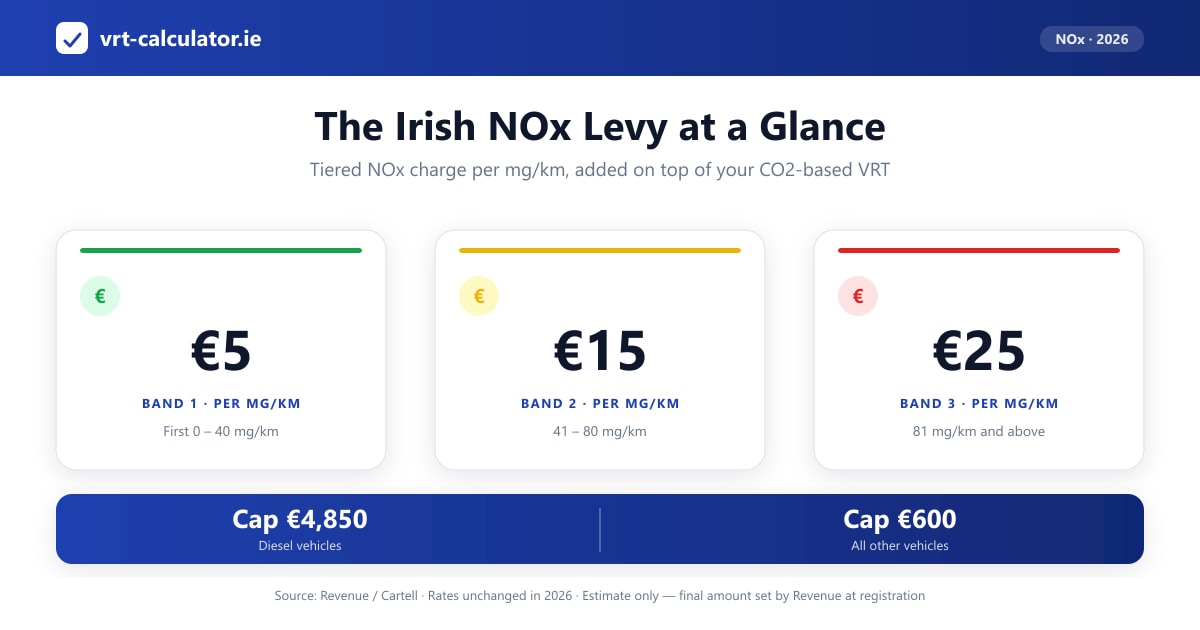
The NOx charge is calculated on a sliding scale: €5 per mg/km on the first 40 mg/km, €15 per mg/km from 41 to 80 mg/km, and €25 per mg/km on every mg/km above 80. Now that the levy is defined, here is the exact band structure a NOx calculator applies.
The three NOx bands and rates
The rate is incremental, not a single flat figure. Each portion of your car's emissions is taxed at the rate for its band, then the parts are added together — the same tiered logic as income tax. The official bands are unchanged in 2026 (Revenue / Cartell):
| NOx emissions band | Rate per mg/km |
|---|---|
| 0 – 40 mg/km | €5 |
| 41 – 80 mg/km | €15 |
| 81 mg/km and above | €25 |
Because higher-emitting cars cross into the more expensive bands, the cost rises sharply for older or dirtier diesels — which is exactly the behaviour the levy is meant to discourage.
Caps and the maximum charge
There is a ceiling on what the levy can cost, which protects buyers of high-emission diesels from an unlimited bill. The NOx charge is capped at €4,850 for diesel vehicles and €600 for all other vehicles (Revenue / Cartell).
One important exception works the other way. If you cannot provide a satisfactory NOx figure for the car, Revenue applies a flat maximum NOx charge of €5,000 (Revenue, 2026). In other words, missing paperwork is penalised harder than a high-emission engine — a strong reason to get your documentation in order before registration.
Worked examples: estimating your NOx charge
A diesel car emitting 60 mg/km of NOx attracts a charge of €500 — €200 on the first 40 mg/km (40 × €5) plus €300 on the next 20 mg/km (20 × €15). The band structure is easiest to grasp with real numbers, so here are two worked calculations.
Example 1: a modern diesel with documentation
A typical Euro 6d diesel imported from the UK might show a NOx figure of 60 mg/km on its Certificate of Conformity. The calculation runs band by band:
- First 40 mg/km: 40 × €5 = €200
- Next 20 mg/km (41–60): 20 × €15 = €300
- Total NOx charge: €500
This €500 is then added to the car's CO2 charge to give the full VRT.
Example 2: no NOx figure available
Now take the same car bought without any documentation. Because no satisfactory NOx value can be shown, Revenue applies the flat maximum of €5,000 (Revenue) — ten times the documented cost in Example 1. For a diesel, the practical ceiling you would expect to see is the €4,850 cap, but the lesson is the same: paperwork is worth real money.
Where to find your car's NOx value
Your car's NOx figure is on its Certificate of Conformity, and on a UK V5C registration certificate it appears in section V.3 — always read it in mg/km, not g/km. Every calculation above depends on this single number, so finding it is the most important step.
Documents that show your NOx figure
The most reliable source is the Certificate of Conformity (CoC), which records the manufacturer's official NOx figure in mg/km (Revenue). If you are buying privately, ask the seller for a hard copy or a scan before you agree a price. The usual sources are:
- Certificate of Conformity (CoC) — the most reliable document.
- V5C registration certificate — UK imports show NOx in section V.3 (Cartell).
- WLTP test report or manufacturer data — useful for newer models.
For heavy-duty vehicles the figure is recorded differently, in g/kWh rather than mg/km (Revenue).
mg/km vs g/km: avoid the conversion trap
The single most common mistake is entering the value in the wrong unit. NOx is taxed per mg/km, but many documents print the figure in g/km. Revenue converts g/km to mg/km by multiplying by 1,000 — so 0.008 g/km becomes 8 mg/km (Revenue).
Which vehicles pay the NOx levy (and which don't)
The NOx levy applies to Category A vehicles first registered from 1 January 2020 — it covers petrol, diesel and hybrid cars, but fully electric vehicles are exempt (Revenue / Cartell). Knowing how to read the figure only matters if your car is actually liable.
The cut-off date is decisive for imports. A car first registered before 1 January 2020 does not attract any NOx charge, regardless of how high its emissions are. That can make an older import noticeably cheaper to register than a newer equivalent.
In summary, you pay the NOx levy if your vehicle is:
- A Category A car (passenger car or car-derived vehicle), and
- First registered on or after 1 January 2020, and
- Petrol, diesel or hybrid (hybrids are included).
You are exempt if the car is fully electric, or was first registered before 1 January 2020.
Frequently asked questions
The most common NOx questions from Irish importers cover the levy's purpose, finding a figure, missing documentation and EV exemptions. Here are quick answers to the points buyers ask most.
What is the NOx levy in Ireland in one sentence?
It is the part of Vehicle Registration Tax charged on a car's nitrogen-oxide emissions, calculated per mg/km and added to the CO2 charge (Revenue).
What happens if there's no NOx figure on the paperwork?
Revenue applies a flat maximum NOx charge of €5,000 where no satisfactory emissions figure can be provided (Revenue). The fix is simple but must happen before registration: obtain the Certificate of Conformity from the seller or the manufacturer so the real, usually much lower, figure can be used.
Do hybrid and electric cars pay the NOx levy?
Hybrids do pay the NOx levy, because they still produce nitrogen-oxide emissions. Fully electric cars are exempt as they emit no NOx (Revenue).
Is the NOx calculator result the final amount I'll pay?
No. A NOx calculator gives a reliable estimate to help you budget, but the binding amount is set by Revenue at registration. Always confirm your figure on the official Revenue VRT calculator before making a financial decision.
Published 15 June 2026 by the VRT Calculator Ireland VRT and import team. Verified against Revenue.ie published rules.