Is VRT payable on electric cars in Ireland?
Yes, VRT is technically payable on every electric car registered in Ireland — but battery electric vehicles (BEVs) qualify for a Revenue-applied relief of up to €5,000 that often cancels the bill entirely. Crucially, this is a relief, not an exemption: you still go through the calculation, and only at the end does Revenue deduct the relief.
Let's start with the most asked question, then peel back the layer underneath: who qualifies, and who doesn't.
- Eligible: new and used battery electric vehicles (BEVs) in Revenue Categories A (passenger) and B (light commercial), provided they're regular production models (Revenue).
- Not eligible: plug-in hybrids (PHEVs) — the dedicated PHEV purchase grant was removed in 2026 and PHEVs are now treated like any other CO₂-rated vehicle for VRT purposes.
- Not eligible: very high-end BEVs whose Revenue OMSP exceeds €50,000 — these pay the standard CO₂-based VRT with no relief.
So if someone tells you "EVs don't pay VRT in Ireland," they're nearly right — but the precise mechanism matters when your car sits near the OMSP thresholds.
How much VRT relief do you get? OMSP thresholds explained
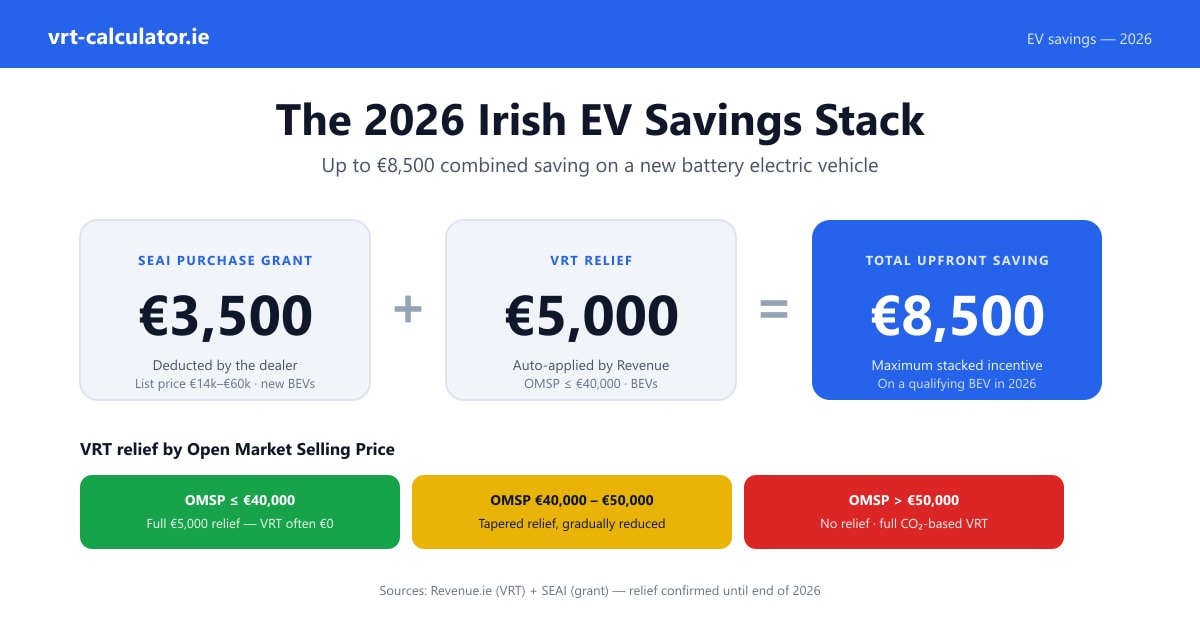
The VRT relief on a new BEV is up to €5,000 if the Open Market Selling Price is €40,000 or below, tapers between €40,000 and €50,000, and disappears completely above €50,000 (Revenue, rules in force until end of 2026). The headline "up to €5,000" hides a sliding scale — knowing the exact thresholds is the difference between paying nothing and paying a four-figure bill.
| OMSP band | VRT relief | Effective VRT (illustrative) |
|---|---|---|
| €0 to €40,000 | Up to €5,000 | Often €0 (relief covers the full CO₂-based VRT) |
| €40,000 to €50,000 | Tapering relief, gradually reduced | Several hundred to a few thousand euros |
| Above €50,000 | No relief | Full CO₂-based VRT applies (8 % or 13.3 % of OMSP) |
Bear in mind that OMSP is Revenue's number, not the invoice. Revenue maintains a depreciated valuation per make/model/version/year and applies it consistently — this can differ from the dealer price you've been quoted. The relief is applied automatically at registration; you don't file a separate claim with Revenue.
Stacking the SEAI grant with the VRT relief: up to €8,500 saved
A new BEV bought from an Irish dealer in 2026 can combine the SEAI Electric Vehicle Purchase Grant of up to €3,500 with the Revenue VRT relief of up to €5,000, giving a maximum upfront saving of €8,500 (SEAI). The VRT relief is one half of the equation — the SEAI grant is the other half, and most buyers don't realise the two stack automatically at the point of sale.
| Mechanism | Amount | How it's applied |
|---|---|---|
| SEAI BEV purchase grant | Up to €3,500 | Dealer deducts it from the price — buyer signs nothing |
| Revenue VRT relief | Up to €5,000 | Applied automatically by Revenue at registration |
| Combined maximum | €8,500 | On a new BEV with OMSP ≤ €40,000 |
The SEAI grant only applies to new BEVs with a list price between €14,000 and €60,000 before any other incentive. Commercial N1 BEVs get a slightly higher grant of €3,800. The dealer files the SEAI application on your behalf, so there's no paperwork friction. Note that the PHEV grant of €2,500 has been removed — only fully battery electric vehicles attract the upfront grant in 2026.
Importing an EV from the UK or Northern Ireland: different rules
Importing a BEV from the UK now stacks 21 % VAT and 10 % customs duty on top of the standard VRT calculation, while a Northern Ireland import escapes customs duty entirely and only attracts VAT if the vehicle is under 6 months old or under 6,000 km. Buying new in Ireland gets you the cleanest stack of incentives — but importing remains popular, especially from NI.
UK import: VAT, customs duty, then VRT
Since Brexit, an EV brought in from England, Scotland or Wales is treated as a third-country import. You owe VAT at 21 % on the OMSP, plus customs duty at 10 % calculated on the price paid for the car (including transport to Ireland), and finally the standard VRT calculation — with the BEV relief still applied if the OMSP qualifies. The relief doesn't cancel VAT or customs duty.
Northern Ireland import: the Brexit exception
A vehicle previously registered to a resident or company in Northern Ireland, or bought from a NI dealer, does not attract customs duty — the Northern Ireland Protocol preserves the customs status quo. VAT only kicks in if the EV is a "new means of transport" under Revenue's definition: under 6 months old OR under 6,000 km on the clock. Above either threshold, no VAT — leaving just the VRT calculation, where the €5,000 relief can still apply if the OMSP fits.
Worked example: a 2026 Tesla Model Y imported from the UK
A 2026 Tesla Model Y Standard Range with an OMSP set by Revenue at €42,500 attracts a tapered VRT relief — effectively paying around €500 in VRT after relief, plus VAT and customs duty on the UK origin, for an all-in tax bill near €13,675 before any SEAI grant (the SEAI grant doesn't apply to imports). Numbers make the relief concrete; here's what a typical UK-to-Ireland EV import actually looks like.
For the same car bought new from an Irish dealer, the customs duty and VAT components disappear and the SEAI €3,500 grant kicks in — for a combined incentive of €8,500. The economics flip dramatically between new and imported, and that's before factoring in shipping logistics.
Beyond the purchase: motor tax, tolls and charging savings
Once an EV is registered in Ireland, ongoing ownership unlocks four further savings: motor tax at €120/year, up to 75 % off M50 tolls under the LEVTI scheme, an SEAI home charger grant, and zero carbon tax on fuel. The VRT relief is one-off, but these ongoing benefits often outweigh the upfront incentives over five years.
- Motor tax — BEVs pay €120/year, the lowest band on the Irish scale, against €200-€600+ for a comparable diesel.
- Tolls — The Low Emission Vehicle Toll Incentive (LEVTI) gives 75 % off M50 charges, 50 % off Dublin Tunnel and 50 % off other national tolls for BEVs.
- Home charger grant — SEAI provides a domestic charger installation grant (current rates on seai.ie).
- Carbon tax — EVs pay zero carbon tax on fuel; with carbon tax rising toward €100/tonne by 2030, that gap will widen.
Common mistakes that cost EV buyers thousands
Three mistakes account for most of the overpayments: assuming the VRT relief is an exemption (and skipping the calculator), miscalculating the UK-vs-NI import rules, and missing the OMSP tipping point at €50,000 where relief drops to zero.
- Treating the VRT relief as an exemption. Buyers assume zero VRT means they can skip the Revenue calculator and budget €0 for tax. In reality, OMSP sometimes lands at €42k when you expected €38k, and a tapered relief leaves a real bill. Fix: always run the official calculator with the exact registration and check the OMSP Revenue assigns.
- Confusing UK and Northern Ireland import rules. A car bought from a Belfast dealer and one bought from a Bristol dealer carry very different total tax bills. Fix: verify the previous registered owner's address before signing — Belfast wins on customs duty; Bristol does not.
- Crossing the €50,000 OMSP cliff. A €1,000 OMSP increase from €49,500 to €50,500 deletes the entire €5,000 relief. Fix: if your shortlist car has an OMSP near the cap, model both scenarios on the calculator before placing the order — sometimes a lower trim level pays for itself.
FAQ: VRT and electric cars in Ireland
Is VRT payable on electric cars imported from England?
Yes. A BEV imported from England, Scotland or Wales pays the standard CO₂-based VRT (with the €5,000 relief still applied if OMSP qualifies), plus VAT at 21 % and customs duty at 10 % on the vehicle's value. The Brexit framework removed the customs duty exemption for UK-origin imports.
What vehicles are exempt from VRT?
Strictly exempt categories (Category D in Revenue's framework) cover ambulances, fire engines and certain mobility-adapted vehicles. Electric cars are not in this exempt category — they qualify for a relief, which is functionally similar at low OMSPs but mechanically different.
Will the EV VRT relief continue after 2026?
The relief is confirmed until end of 2026 in current legislation. Any extension or modification beyond that depends on the next Budget. We'll update this guide as soon as Revenue publishes new rules.
Can I claim the VRT relief on a used EV import?
Yes, the BEV VRT relief applies to both new and used electric vehicles as long as the OMSP that Revenue assigns falls in the eligible band (Revenue). A used Tesla Model 3 imported from NI with an OMSP of €28,000 would still receive the full €5,000 relief.
What happens if my EV's OMSP is above €50,000?
You pay the full CO₂-based VRT with no relief. For a BEV (0 g/km, 8 % band), that's 8 % of OMSP — on a €55,000 car, that's €4,400 in VRT. Combined with VAT and customs duty on UK imports, this often makes a same-model import economically irrational vs buying new from an Irish dealer.
Published 22 May 2026 by the VRT Calculator Ireland editorial team.