Importing a car from the UK to Ireland in 2026 usually adds around 40% to the UK purchase price: for a car from Great Britain you pay Customs Duty (10%), Import VAT (23%), Vehicle Registration Tax (VRT) of 7%–41% of the OMSP, and a NOx levy before you can legally drive it.
Since Brexit, a car from Great Britain is treated as an import from a non-EU third country, which is what triggers customs duty and import VAT on top of the VRT that every registered vehicle pays. This guide covers the full cost, the practical steps and deadlines, and the one factor that changes everything — whether the car comes from Great Britain or Northern Ireland.
How much does it cost to import a car from the UK to Ireland?
On a car from Great Britain, the cost to import to Ireland stacks four charges: 10% customs duty, 23% import VAT, VRT of 7%–41% of the OMSP, and a NOx levy of €5–€600 — often adding thousands of euros on top of the purchase price. The VRT is based on the Open Market Selling Price (OMSP) set by Revenue, not the price you actually paid in the UK.
The four taxes on a car from Great Britain
Each charge has its own base and is collected by Revenue at import or at registration, so budget for all four rather than VRT alone:
- Customs Duty — charged on the purchase price plus transport costs.
- Import VAT — charged on the customs value (price + transport + duty), at 23%.
- VRT — based on the OMSP and CO₂ emissions, paid at the NCTS centre.
- NOx levy — tiered by the vehicle's nitrogen oxide emissions.
Worked example: a 2019 BMW 320d imported from Great Britain
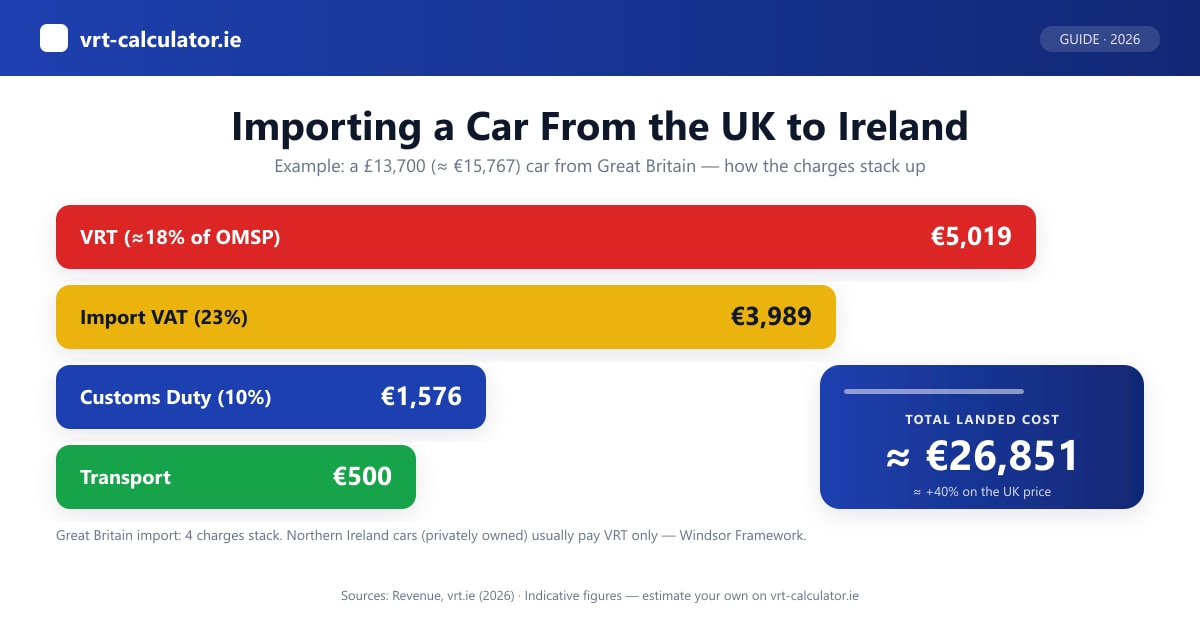
Take a 2019 BMW 320d SE bought in England for £13,700 (≈ €15,767) — a very common UK-to-Ireland import, where the Irish OMSP set by Revenue sits near €28,000. The table below shows how the charges build up to the total landed cost.
| Cost component | Rate | Amount |
|---|---|---|
| Purchase price | £13,700 → €15,767 | €15,767 |
| Customs Duty | 10% | €1,576 |
| Import VAT | 23% | €3,989 |
| VRT | ~18% of OMSP | €5,019 |
| Transport | estimated | €500 |
| Total | ≈ €26,851 |
Great Britain vs Northern Ireland: why origin changes everything
Where the car comes from decides what you pay: a car from Great Britain is fully taxed, while a car genuinely owned and used in Northern Ireland is treated as an EU good under the Windsor Framework and usually pays VRT only. Those headline costs assume a Great Britain import — origin is the single biggest lever on the final bill.
Great Britain imports: the full tax bill
A car from Great Britain (mainland UK) attracts the complete set of charges: customs duty, import VAT, VRT and the NOx levy. There is no exemption unless Transfer of Residence relief applies, so the €8,000–€12,000 in extra taxes seen on many popular models comes almost entirely from this stack.
Northern Ireland imports: VRT only (with proof)
Under the Windsor Framework, a car genuinely used and privately owned in Northern Ireland is treated as an EU good, so no customs duty and no import VAT apply — only VRT. You must prove the vehicle's status with:
- A V5C logbook showing the last keeper based in Northern Ireland.
- The Northern Ireland MOT test history confirming genuine use there.
Step by step: how to import and register the car
To import a car legally, you complete a customs declaration before it enters Ireland, book an NCTS appointment within 7 days of arrival, and register and pay VRT within 30 days — miss the deadline and you face penalties. Now that cost and origin are clear, here is the practical sequence.
Before you buy: checks, insurance and documents
Professionals recommend a full legal and physical inspection of the vehicle in the UK before purchase, plus an insurance quotation in advance, as Irish insurers apply specific rules to imports. Have these ready:
- V5C logbook and proof of UK purchase.
- Valid MOT, service history and a UK history check.
- An EORI number for the customs declaration.
On arrival: NCTS appointment and the 30-day rule
Once the car reaches Ireland, the clock starts. Follow these steps in order:
- Complete the customs declaration at the point of entry.
- Book your NCTS appointment within 7 days of arrival.
- Present the vehicle and pay VRT to register within 30 days.
Paying VRT, VAT and customs at registration
Customs duty and import VAT are settled with Revenue at import, while VRT is paid at the NCTS centre when the vehicle is registered. Once cleared, you receive your Irish registration number and can order number plates.
Is it worth importing a car from the UK in 2026?
Importing from the UK is still worth it in 2026 for the right car — high-spec models, EVs and classics over 30 years old — where the UK–Ireland price gap outweighs the stacked taxes; for ordinary used cars, the savings are often gone. The decision comes down to whether the maths works for your specific vehicle.
Which cars still make financial sense
Importing pays off mainly when the price gap is large or a relief cuts the VRT:
- EVs (≤ €40k OMSP): up to €5,000 VRT relief, often wiping out VRT entirely.
- Classics (30+ years): a flat €200 VRT, a major saving on high-value cars.
- Luxury and rare models: where UK stock is cheaper or unavailable in Ireland.
Get an accurate estimate before you commit
The only way to know your real figure is to price your exact vehicle, because Revenue's OMSP — not your invoice — drives the VRT. Enter your car's details into the VRT calculator to estimate the amount in seconds before you buy.
Frequently asked questions
Beyond the headline costs and steps, a few specific questions tend to decide whether the import goes smoothly.
How can I import a car from the UK without paying VRT?
The only legitimate route is the Transfer of Residence relief. You must have lived outside Ireland for at least 12 months, owned and used the vehicle for at least 6 months before moving, and be establishing your primary residence in Ireland.
What proof do I need for a Northern Ireland car?
To claim EU-good status you need a V5C naming a Northern Ireland keeper and the NI MOT history showing genuine use there. Without that evidence, Revenue treats the car as a Great Britain import and the full charges apply.
How much is the NOx levy?
The NOx levy ranges from €5 to €600, tiered by the vehicle's nitrogen oxide emissions. Cleaner petrol and electric cars sit at the low end; older diesels pay significantly more.
Can I drive the car before it is registered?
No. Driving an unregistered import on Irish roads is not permitted, so arrange registration and insurance first, then order your number plates once the car is registered.
Published 2 July 2026 by the VRT Calculator Ireland editorial team.