VRT on a classic car in Ireland is a flat €200 when the vehicle is more than 30 years old and accepted by Revenue as a vintage vehicle (VRT Category C). That single charge replaces the usual calculation based on the car's value and emissions, which is exactly why a 1985 saloon costs the same €200 to register as a rare 1960s sports car. The catch is in the wording: a "classic" is not automatically a "vintage" vehicle for tax, and the favourable rate only applies once Revenue is satisfied the car is genuinely over 30 years old. This guide walks through the exact amount, the age threshold, the ZV plate option, how to register an imported classic, and what to do if Revenue gets the classification wrong. If you just want the number for your own car, you can also run it through our VRT calculator.
Do you have to pay VRT on a classic car in Ireland?
Yes — you still have to pay VRT to register a classic car in Ireland, but if it is over 30 years old it is a flat €200 instead of the usual emissions-based charge (source: vrt.ie / Revenue). Registration is not optional: Vehicle Registration Tax (VRT) is due whenever a vehicle is registered in the State for the first time, including a car you have owned abroad for years and are only now putting on Irish plates. What changes for a genuine vintage vehicle is how much you pay, not whether you pay.
The good news for owners is that this is one of the cheapest VRT outcomes possible. A modern import can attract hundreds or thousands of euro in VRT, while a qualifying classic is capped at the fixed €200.
Flat rate vs full exemption: clearing up the confusion
The most common myth online is that a car over 30 years old is "totally exempt" from VRT. That is incorrect. Several third-party pages describe an exemption, but the sources most consistent with Revenue and NCTS rules point to a flat €200 charge, not zero. The distinction matters: an exemption would mean filing nothing, whereas a flat charge means you still complete the registration process and pay €200. Treat any "tax-free classic car" claim with caution and budget for the €200.
How much is VRT on a classic or 30-year-old car?
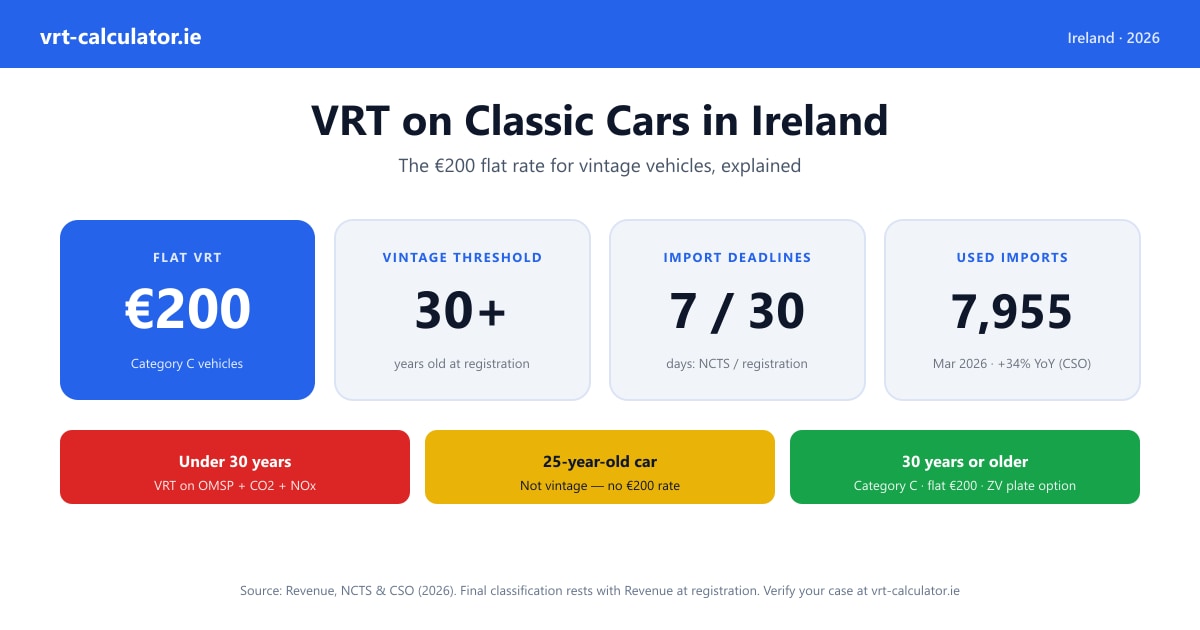
VRT on a 30-year-old car in Ireland is a fixed €200, because vehicles over 30 years fall into VRT Category C with a flat charge rather than the OMSP- and emissions-based calculation (source: Revenue applying-tax, vrt.ie). OMSP stands for Open Market Selling Price — the value Revenue assigns to a car — and for ordinary vehicles VRT is built from that figure plus a CO₂ emissions charge and a NOx charge. Category C skips all of that with a single number. Here is how the outcomes compare by age and status.
| Vehicle age / status | VRT treatment | Category | VRT amount |
|---|---|---|---|
| Under 30 years old | Charged as a normal vehicle | Category A / B (by type) | Calculated on OMSP + CO₂ + NOx |
| 30 years or older (accepted vintage by Revenue) | Vintage / classic | Category C | €200 flat |
| ZV plate option (30 years+) | Optional registration plate | n/a | No extra cost for the plate |
Source: Revenue Commissioners, 2026 — revenue.ie/en/vrt/calculating-vrt/applying-tax.aspx.
Why the official VRT calculator can't price a classic car
The official ROS VRT Calculator will not give you a figure for a vintage car, and that surprises a lot of owners. The tool itself states that it does not cover classic, collectable or vintage vehicles (along with tractors and large commercials), because those sit outside its OMSP-driven model (source: ros.ie). For a genuine over-30 classic you do not need the calculator at all — the answer is simply €200. The official calculator is built for cars whose VRT depends on value and emissions, which is precisely what Category C removes.
What counts as a vintage or classic car for VRT? (the 30-year rule)
For VRT, a vintage car is one that Revenue accepts as being more than 30 years old at the date of registration — and a 25-year-old car does not qualify (source: NCTS, vrt.ie). The phrase "to the satisfaction of Revenue" is doing real work here: the burden is on the owner to prove the age and identity of the vehicle, not simply to declare it. That date is measured at registration, so a car edging towards the threshold can cross into vintage status as it ages.
Classic vs vintage: why the words matter for tax
In everyday and insurance language, "classic" is a marketing and cover term that can apply to cars far younger than 30 years. For tax, though, "classic car" is not a separate VRT category — only the "vintage = over 30 years" test counts (source: Revenue/NCTS). So a car your insurer happily calls a "modern classic" may still be charged ordinary VRT if it has not yet reached 30 years. When budgeting, ignore the brochure language and check the build date.
Popular models now over 30 years old (and eligible)
Because the test rolls forward every year, the list of qualifying cars keeps growing. In 2026, "more than 30 years old" means a car first registered around 1995 or earlier. Some popular imports and modern classics that now clear the threshold:
| Marque | Examples now over 30 years old |
|---|---|
| Volkswagen | Golf Mk1 & Mk2 (incl. GTI), Beetle, T25/T3 Transporter |
| BMW | E30 3 Series, E28/E34 5 Series, E24 6 Series |
| Mercedes-Benz | W123, W124, 190E (W201), R107 SL |
| Ford | Escort Mk2–Mk4, Sierra & Sapphire (incl. Cosworth), Capri |
| Porsche | Air-cooled 911 (pre-1995), 944, 928 |
| Japanese icons | Mazda MX-5 Mk1 (NA), Toyota Corolla AE86, Nissan Skyline R32 |
| British classics | Mini, MGB, Triumph Spitfire, Jaguar E-Type & XJS |
Eligibility is judged on the date of first registration, to Revenue's satisfaction — always confirm the build/registration date before relying on vintage status. Source: Revenue/NCTS, vrt.ie.
ZV plates and registering a vintage car
If your car is over 30 years old, you can choose a ZV registration plate instead of a standard plate, and the plate itself comes at no extra cost (source: Revenue ZV plates, vrt.ie). A ZV registration is the distinctive identifier associated with vintage vehicles in Ireland, and it pairs naturally with a Category C registration. Crucially, it is an option, not an obligation — owners who prefer a standard registration can keep one.
Choosing a ZV plate does not change the €200 VRT you pay; it is a presentation and identity choice rather than a tax one. Many enthusiasts opt for it precisely because it signals the car's vintage status. Key points to keep in mind:
- The ZV plate is available only for vehicles over 30 years old.
- There is no additional cost for the plate itself beyond normal registration.
- It is optional — a standard registration remains available.
Importing a classic car: step-by-step registration at the NCTS
To register an imported classic car in Ireland you must book an NCTS appointment within 7 days of the car entering the State and complete registration within 30 days, then pay the €200 Category C VRT (source: NCTS). The NCTS (National Car Testing Service) runs the registration appointments on Revenue's behalf, and most Irish classics arrive this way — the import market is busy, with 7,955 used passenger cars imported in March 2026, up 34% year on year (source: CSO). Getting the sequence right keeps you inside the deadlines.
Deadlines and documents you need
The timeline is tight, so prepare your paperwork before the car lands. Bring the foreign registration certificate and, for a used import, the information needed on CO₂ and NOx, since Revenue may ask for supporting detail on the vehicle's identity and age (source: NCTS). Work through it in order:
- Book an NCTS appointment within 7 days of the vehicle entering the State.
- Bring the foreign registration certificate and proof of the car's age and identity.
- Provide the CO₂ and NOx information requested for a used import.
- Attend the appointment and complete registration within 30 days.
- Pay the €200 Category C VRT on a confirmed vintage vehicle.
Proving the car's age when paperwork is missing
When Revenue misclassifies your classic car (and how to challenge it)
If Revenue classifies your classic car as something else — such as a camper — instead of a vintage Category C vehicle, you can pay the assessed VRT first and then formally request a review or rebate. This is the practical advice a Complete Car advisor gives for exactly this situation: pay, then challenge, backed by the written opinion of an old-car club or marque club, and, if needed, a legal letter explaining why the vehicle should be treated as a classic (source: completecar.ie). Revenue can require evidence of the vehicle's age and identity, so documentation is your strongest tool.
FAQ: VRT on classic cars in Ireland
Beyond the €200 flat rate, a few practical questions come up repeatedly about NCT, deadlines and import VAT — here are direct answers that the sections above do not cover.
Are vintage cars exempt from the NCT?
The NCT (National Car Test) is separate from VRT, and vintage vehicles are commonly treated differently from ordinary cars for roadworthiness testing. Because the exact testing obligation depends on the vehicle, confirm your specific car's NCT position directly with the NCTS rather than assuming a blanket exemption.
What happens if you register an imported classic car late?
Missing the registration deadlines can expose you to late-registration penalties. The rule is an NCTS appointment within 7 days and registration within 30 days of the car entering the State (source: NCTS); registering after that window risks penalty charges on top of the €200 VRT. Book early to stay clear of any late-payment exposure.
Do you pay VAT when importing a vintage car?
VAT can apply on import separately from VRT, depending on the vehicle's status and origin (source: carzone). VAT and VRT are two different charges, so a car can be clear on one and still attract the other. Check your specific import route with Revenue before you commit to a purchase abroad.
Published 3 June 2026 by the VRT Calculator Ireland editorial team, specialists in Irish VRT. Reviewed using Revenue Commissioners and NCTS primary sources.