The cheapest cars for VRT in Ireland are fully electric models under €40,000 — effectively €0 after the €5,000 relief — and classic cars over 30 years old, which pay a flat €200. Because Vehicle Registration Tax (VRT) is driven by CO₂ emissions and the car's Open Market Selling Price (OMSP) rather than the price you actually pay, the same money can buy you a car that costs hundreds in tax or one that costs thousands. This guide names the specific low-VRT cars worth shortlisting in 2026, explains why they sit at the cheap end, and shows how to put a figure on your own bill before you commit.
How VRT works: why some cars are cheap and others cost thousands
VRT is calculated as a percentage of a car's Open Market Selling Price (OMSP), and that percentage rises with the car's CO₂ emissions — so a low-emission car is automatically a low-VRT car. Before naming the cheapest models, it helps to understand the one rule that decides them all. There is no fixed VRT price per model; the Revenue Commissioners run every car through the same formula.
OMSP: the value your VRT is based on
The OMSP is the price the Revenue Commissioners judge your car would sell for on the Irish market — not the price you paid abroad. If you import a bargain, you are still taxed on Irish market value, which is why cheap foreign deals do not always translate into a cheap VRT bill. Two identical cars therefore carry the same VRT even if one was bought for far less. Knowing the OMSP is the starting point for any realistic estimate.
CO₂ bands: the single biggest lever on your bill
Your CO₂ figure decides which band applies, and the band decides the rate. The scale runs from Band 1 (0–50 g/km) at 7% of OMSP or €140, whichever is greater, up to Band 20 (more than 190 g/km) at 41% or €820 (Revenue, bands applying from 2022). A few reference points show how steeply the cost climbs:
- Band 1 — 0–50 g/km — 7% (minimum €140)
- Band 6 — 96–100 g/km — 12%
- Band 20 — over 190 g/km — 41% (minimum €820)
Every extra gram of CO₂ pushes you toward a higher percentage of the OMSP, so emissions are the lever that matters most.
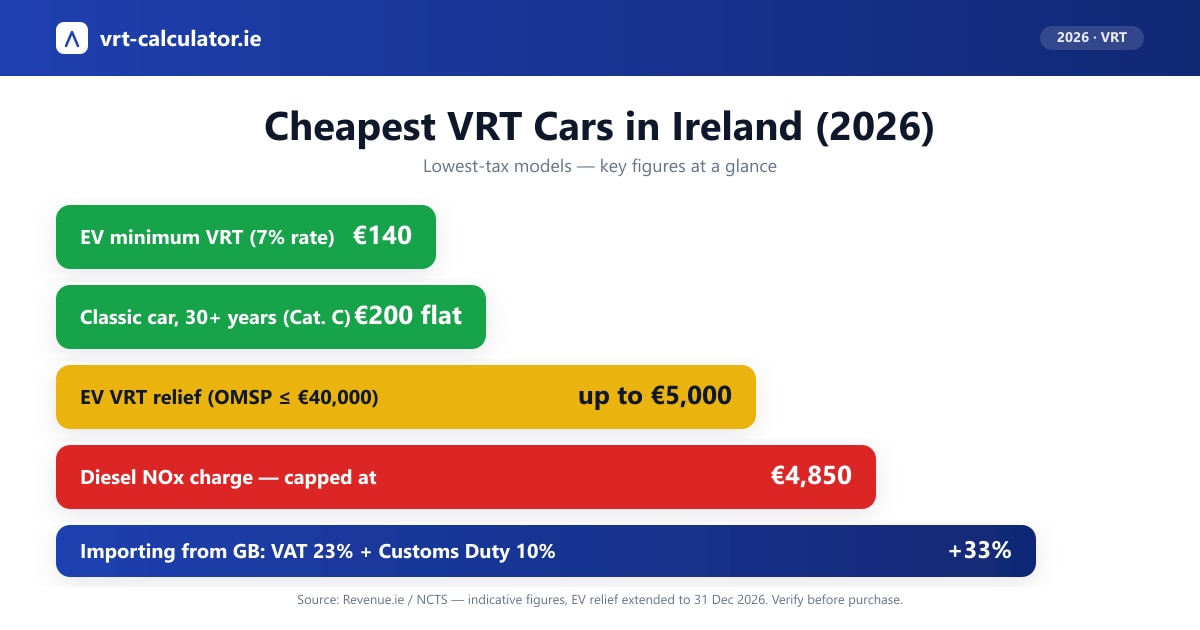
The cheapest cars for VRT in Ireland right now
The lowest-VRT cars fall into three groups: electric cars under €40,000 (about €0), classic cars over 30 years old (€200 flat), and low-emission plug-in hybrids (roughly €1,700–€2,500). With the CO₂-to-OMSP rule in mind, here are the specific cars that consistently attract the lowest VRT.
| Model | Fuel type | CO₂ (g/km) | VRT band / rate | Estimated VRT |
|---|---|---|---|---|
| Dacia Spring Expression | Electric | 0 | 7% + relief | ~€0 |
| MG4 EV / Renault Zoe / Kia Niro EV | Electric | 0 | 7% + relief | ~€0 |
| BMW 530e | Plug-in hybrid | ~30 | Band 1 (7%) | €1,700–€2,200 |
| BMW 330e | Plug-in hybrid | ~35 | Band 1 (7%) | ~€2,000–€2,500 |
| Toyota Corolla Hybrid | Hybrid | ~100 | Band 6 (12%) | €3,000–€5,000 |
| Classic car 30+ years | Any | n/a | Category C | €200 flat |
| VW Golf 2.0 TDI | Diesel | high | high band + NOx | €6,000+ |
Electric cars: the cheapest modern option
Fully electric cars are the cheapest modern choice because a 0 g/km rating puts them in the lowest band and the relief removes most of what remains. The cheapest electric car eligible for relief starts at around €16,000 (Dacia Spring Expression), with VRT effectively reduced to €0 for models under €40,000 (MoneyGuideIreland, 2026). Popular value options such as the MG4 EV, Renault Zoe and Kia Niro EV all sit in the same effectively-VRT-free bracket.
Classic cars over 30 years: the €200 flat rate
Cars manufactured 30 or more years ago fall into Category C and pay a flat €200, regardless of value, engine size or emissions. This makes an older classic the most predictable low-VRT route for enthusiasts, since no CO₂ or NOx calculation applies. A car registered in 1995 or earlier qualifies in 2026, and importing a 30-plus-year-old vehicle from Northern Ireland or Great Britain is a reliable way to keep the registration cost down.
Low-emission plug-in hybrids: the middle ground
Plug-in hybrids sit between electric cars and combustion models, and the best of them land in the lowest CO₂ band. Cars like the BMW 530e and 330e are frequently cited by Irish importers as the "best value" imports because their low CO₂ rating pairs with a favourable OMSP, producing a VRT of roughly €1,700–€2,500. They will not match an EV's near-zero bill, but they undercut most petrol and diesel equivalents comfortably.
Electric cars and the €5,000 VRT relief explained
Fully electric cars pay a base VRT of 7% of OMSP but qualify for a relief of up to €5,000 when the OMSP is €40,000 or less, which wipes out the VRT on most affordable EVs. Electric cars top the cheapest list mainly because of this one scheme, so it is worth understanding exactly how it tapers. Crucially, an EV is not fully exempt — it receives a relief, and above a certain price that relief disappears.
- OMSP €40,000 or less — full relief of up to €5,000, so most EVs are effectively VRT-free.
- OMSP €40,000–€50,000 — relief reduced by 50% of the amount over €40,000.
- OMSP over €50,000 — no relief applies; the car pays the full 7%.
The relief was extended in Budget 2026 to 31 December 2026 (Revenue), so the window remains open for buyers this year.
The NOx levy: why diesel cars have the highest VRT
Diesel cars usually carry the highest VRT in Ireland because they combine a high CO₂ band with a NOx levy capped at €4,850 for diesels — far above the €600 cap that applies to petrol and other cars. If electric and classic cars sit at the cheap end, diesels sit firmly at the expensive end, and the NOx levy is a big reason why. The levy is added on top of the CO₂-based VRT, so a large diesel is hit twice.
In practice, larger diesels such as a VW Golf 2.0 TDI or executive saloons can push the total VRT into the €6,000–€12,000+ range once the high band and NOx charge are combined. For a budget-conscious buyer chasing the cheapest VRT cars, a big diesel is the clearest example of what to avoid.
Buying VRT-included in Ireland vs importing from abroad
Buying a used car already registered in Ireland means the VRT is "included" and already paid, while importing from Great Britain adds 23% VAT and 10% customs duty on top of the VRT. Knowing which cars are cheap on VRT only pays off if you also pick the right way to buy them. Each route has a different cost profile:
- VRT-included Irish used car — the tax is already settled and shown in the asking price; no calculation or appointment needed on your side.
- Import from Great Britain — expect VRT plus 23% VAT and 10% customs duty, and a NOx charge where it applies.
- Import from Northern Ireland — may avoid VAT and customs duty under certain conditions, though VRT is still payable unless the car is exempt.
For many buyers, a VRT-included car removes the risk of an OMSP surprise, while importing can still win on the right low-VRT model.
How to estimate your VRT before you buy
You can estimate your VRT before buying by checking the car's OMSP band and CO₂ figure with an online VRT calculator, then confirming the final amount at your NCTS appointment. Once you have shortlisted a low-VRT car, the last step is to put a number on it before you commit. The NCTS collects and confirms VRT on behalf of the Revenue Commissioners, so the figure you get at the centre is the one that counts.
- Find the car's CO₂ figure and identify its band.
- Estimate the OMSP (Revenue's Irish market valuation, not the purchase price).
- Run the numbers through a VRT calculator to get an indicative figure.
- Confirm the final amount at your NCTS appointment, where VRT is collected for Revenue.
Frequently asked questions about cheap VRT cars
Beyond the cheapest models, buyers most often ask about full exemptions, the exact age rule for classics, and whether the EV relief applies to used imports. A few practical questions come up again and again once buyers have their shortlist.
What cars are completely exempt from VRT in Ireland?
Full VRT exemptions apply to specific vehicle categories rather than ordinary cars — for example ambulances, fire engines, State-owned and diplomatic vehicles, and vehicles adapted exclusively for people with disabilities (Category D, Revenue). Everyday electric cars are not exempt; they receive a relief, while classics pay the €200 flat rate.
How old does a car have to be for the €200 flat VRT?
A car must be 30 or more years old to qualify for the historic vehicle category and its flat €200 rate. In 2026 that means a vehicle manufactured in 1995 or earlier, which then falls into Category C with no CO₂ or NOx calculation.
Can I legally reduce or avoid paying VRT?
Yes — legitimate routes include claiming a transfer of residence exemption when moving to Ireland, importing an eligible car from Northern Ireland (which may avoid VAT and customs duty), or choosing an EV that qualifies for the €5,000 relief. Each has strict conditions set by Revenue.
Does the €5,000 EV relief apply to used or imported electric cars?
The relief applies to electric cars with an OMSP of €40,000 or less, including imported EVs, so a used electric import can still benefit. Above €40,000 the relief tapers, and it disappears entirely once the OMSP passes €50,000.
What low-VRT car can I get for around €150 a month?
On a tight monthly budget, a used low-emission hybrid or an affordable electric car offers the best balance, because the near-zero VRT keeps the total cost down. An older classic can also work for occasional use, thanks to its fixed €200 registration cost.
Published 13 July 2026 by the VRT Calculator Ireland editorial team, specialists in Irish vehicle registration tax and vehicle imports. Figures reflect Revenue Commissioners VRT rules and Budget 2026.