Yes — you pay VRT on a tractor in Ireland. Agricultural tractors are Category C and are charged a flat 13.3% of their Open Market Selling Price (OMSP), with a minimum of €200. In practice this Vehicle Registration Tax is triggered when a tractor is registered here for the first time, which almost always means an imported machine — most often bought in the UK or Northern Ireland. The tax is collected by Revenue and must be paid promptly: you have 30 days from the date the tractor enters the State to register it and settle the VRT. Below you will find the exact rate, a worked cost example, the documents you need, and the step-by-step process. To estimate your own bill first, you can run the figures through our VRT calculator.
Do you have to pay VRT on a tractor in Ireland?
You must pay VRT on a tractor whenever it is registered in Ireland for the first time, which in practice means almost every imported tractor. VRT is a registration tax, not a recurring road tax: it is charged once, at the point the vehicle is brought onto the Irish register, and it is collected by Revenue.
VRT vs Variable Rate Technology — clearing up the confusion
One quick clarification before going further. VRT here means Vehicle Registration Tax, the Irish import tax. It is not "Variable Rate Technology", the precision-farming term that shares the same initials. This guide is entirely about the tax you pay to register a tractor — nothing to do with seed or fertiliser dosing.
When VRT applies (and when it might not)
VRT is triggered by first registration in the State. If you buy a tractor that has never been registered in Ireland — typically a used import from the UK or Northern Ireland — it has to be registered and the VRT paid. The key rule to remember is the deadline: registration must happen within 30 days of the vehicle entering the State (source: Revenue.ie). A tractor already registered in Ireland and simply changing hands does not generate a fresh VRT charge. If a machine is used purely off-road on the farm and never registered for road use, the practical position can differ, but as soon as it needs to go on the register, Category C rules apply.
- Imported (UK / NI): VRT due on first Irish registration.
- Already Irish-registered: no new VRT on resale.
- Deadline: 30 days from entry to the State.
How much is VRT on a tractor? The rate and Category C explained
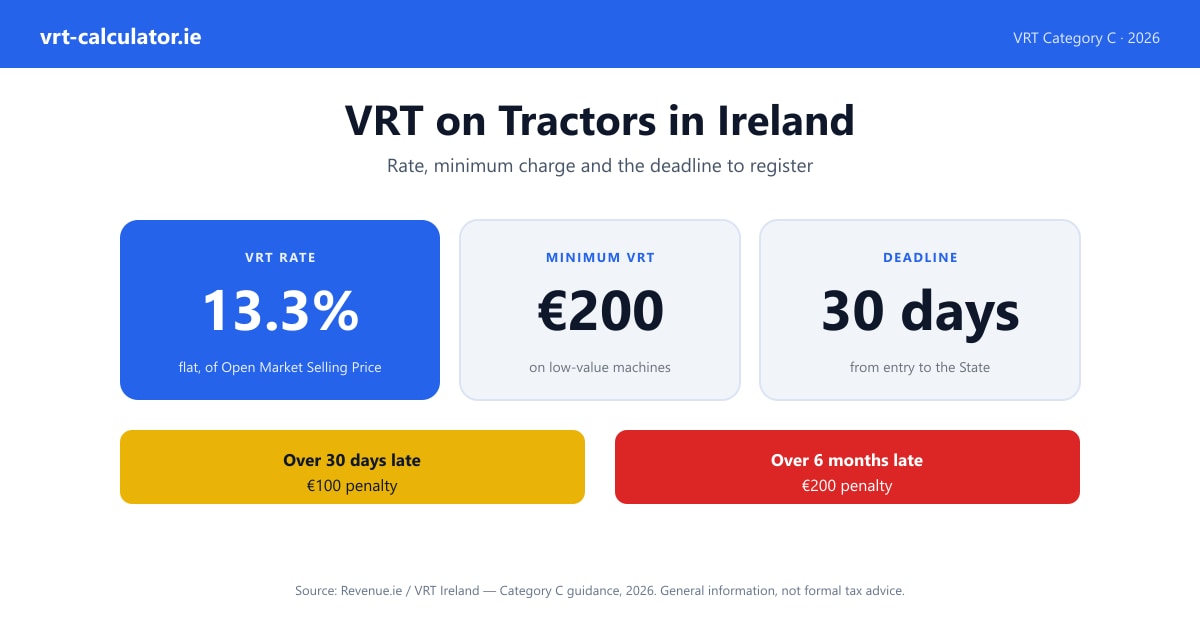
VRT on an agricultural tractor is a flat 13.3% of the Open Market Selling Price, with a minimum charge of €200, because tractors sit in VRT Category C. This is the same rate applied to other commercial vehicles, regardless of engine size or emissions (source: vrt.ie). That flat structure is good news for buyers of higher-spec machines, because there is no CO₂ or NOx loading as there is on cars.
| Item | Detail |
|---|---|
| VRT category | Category C |
| VRT rate | Flat 13.3% of OMSP |
| Minimum VRT | €200 |
| Late penalty | €100 (over 30 days) / €200 (over 6 months) |
| Deadline | Register within 30 days of entry to the State |
| Main form | VRTVPD2 |
| Where | NCTS centre handling Category C vehicles |
Source: Revenue Commissioners & vrt.ie, 2026 — revenue.ie/en/vrt.
What is VRT Category C?
Category C is Revenue's class for larger commercial vehicles, agricultural tractors and buses (with at least 10 seats). It maps to EU classification codes M2, M3, N2, N3 and T1–T5 (source: vrt.ie). Vehicles more than 30 years old at registration are also treated as Category C, and on request these can be issued with a ZV licence number.
What is the OMSP and why it matters
The 13.3% is applied to the Open Market Selling Price, which is Revenue's view of the vehicle's value on the Irish market — not necessarily the price you actually paid. If you bought a bargain abroad, the VRT can still be calculated on the higher OMSP, so it pays to know this figure before you commit.
Worked example: VRT on a €20,000 tractor
Common tractor makes and models imported into Ireland
The flat Category C rate applies to every make — there is no CO₂ or engine-size loading, so the brand only matters for the OMSP Revenue assigns. The makes most often registered here:
| Make | Popular models imported |
|---|---|
| Massey Ferguson | 135 & 35X (vintage), 165, 290, 390, 6100/6200 series |
| John Deere | 30/40 Series, 6010 & 6R series, 7700 |
| Ford / New Holland | Ford 3000–7610 & TW series; New Holland TM, T6, T7 |
| Case IH | Maxxum, Magnum, Puma, MX |
| Fendt / Deutz-Fahr / Valtra | Fendt 700/900 Vario, Deutz-Fahr Agrotron, Valtra N/T |
| Zetor / Landini / McCormick | Zetor Crystal & Proxima, Landini, McCormick X-series |
How to VRT a tractor: step-by-step process and documents
To VRT a tractor you book an appointment at an NCTS centre that handles Category C vehicles, bring the foreign log book, invoice, PPSN proof, ID and a completed VRTVPD2 form, and pay on the day. Not every NCTS centre processes tractors, so confirm by phone first and check your exact model is listed.
Documents you need
Get the paperwork right and the appointment is straightforward; this is where most farmers come unstuck. You will need:
- The foreign log book or UK registration certificate (the original, not a photocopy).
- An invoice or receipt for the machine, with the price entered in the original currency you paid, not converted euros.
- An official document showing your PPSN, dated within the last 6 months.
- Photo ID — driving licence or passport.
- A completed VRTVPD2 form.
- The location of the stamped chassis number on the machine — a riveted VIN plate is not accepted.
The VRT appointment, step by step
Once your documents are in order, the process runs in a clear sequence:
- Book an appointment at an NCTS centre that handles Category C vehicles, confirming your model is listed.
- Bring the tractor and the full document set above.
- The centre inspects the machine and verifies the stamped chassis number.
- Revenue calculates the VRT (13.3% of OMSP, or the €200 minimum).
- You pay the VRT and receive your registration.
Reliefs, road use and common mistakes to avoid
Registered farmers can usually treat tractor VRT as a business cost and recover VAT, but the most expensive mistakes are missing the 30-day deadline and turning up without the right documents. Knowing both sides — the savings and the pitfalls — keeps the bill down.
Tax reliefs for registered farmers
A tractor is a business asset, so the tax treatment is generally favourable for working farms. Where you qualify:
- Capital allowances can be claimed on the full purchase price, including the VRT itself.
- VAT-registered farmers can recover the VAT on the purchase.
- Some government grants may be available for qualifying agricultural machinery — check with the Department of Agriculture, Food and the Marine.
Penalties and the mistakes that cost farmers
Leave VRT too late and Revenue applies escalating penalties: €100 once you are over the 30-day deadline, rising to €200 when you go beyond 6 months. The other costly errors are practical: bringing a photocopied log book, an out-of-date PPSN document, or a machine where the chassis number cannot be located. If you intend to use the tractor on public roads, remember you also need motor tax and insurance, with a 40 km/h limit and proper lighting.
Frequently asked questions about VRT on tractors
A few specific situations come up again and again when registering a tractor.
Do registered farmers get a VRT exemption on tractors?
No — there is no blanket VRT exemption for farmers. Tractors are still Category C and the 13.3% rate applies. What farmers get instead are reliefs: capital allowances and VAT recovery that reduce the overall cost.
Do you pay VRT on a tractor imported from Northern Ireland?
Yes. A tractor brought in from Northern Ireland that has not been registered in the State is treated as a first registration, so the Category C VRT applies and the same 30-day deadline runs from when it enters the State.
What happens if you miss the 30-day VRT deadline?
You face penalties: €100 once you pass 30 days, increasing to €200 beyond six months. Registering promptly is always cheaper than letting the clock run.
Do you pay VAT as well as VRT on an imported tractor?
You can. VAT and VRT are separate charges — VRT is the registration tax, VAT may also be due on the import. VAT-registered farmers can typically recover the VAT, but the VRT itself stands.
Is a vintage (30+ year) tractor treated differently?
A tractor over 30 years old at registration is classed as Category C as a vintage vehicle and, on request, can be issued with a ZV licence number. The €200 minimum still applies.
Published 5 June 2026 by the VRT Calculator Ireland editorial team, specialists in Irish vehicle registration tax. Verified against current Revenue and vrt.ie Category C guidance.