What qualifies as a commercial vehicle for VRT in Ireland
Whether VRT is cheap or expensive on your vehicle depends first on its VRT category, set by the vehicle's EU type-approval classification (N1, M1) and its seats and weight (Revenue VRT Manual, Section 01a). Passenger vehicles classed M1 are Category A; light commercial vehicles classed N1 are generally Category B. Getting this right matters, because it decides whether you pay a percentage of value or a fixed fee.
Category B: most vans and car-derived/jeep-derived vans
Most light commercial vehicles fall into Category B. Under Revenue's rules, an EU Category N1 vehicle built for carrying goods and not exceeding 3.5 tonnes is taxed as Category B — covering the bulk of the market:
- Panel vans and light goods vehicles
- Car-derived vans and jeep-derived vans
- Crew cabs that keep four or more eligible seats
A practical tip: check the body type on the V5C before you buy. Entries such as "Panel Van" and "Light Goods Vehicle" are reliable Category B candidates.
Category C: heavy and qualifying commercial vehicles
Category C is a flat €200, regardless of value. A light commercial vehicle is classed Category C only when, as an N1, it has fewer than 4 seats and its technically permissible maximum laden mass exceeds 130% of its mass in service — alongside large commercials, buses and tractors. For a high-value qualifying vehicle, this fixed fee is often far cheaper than a percentage of OMSP.
Commercial vehicle VRT rates in 2026
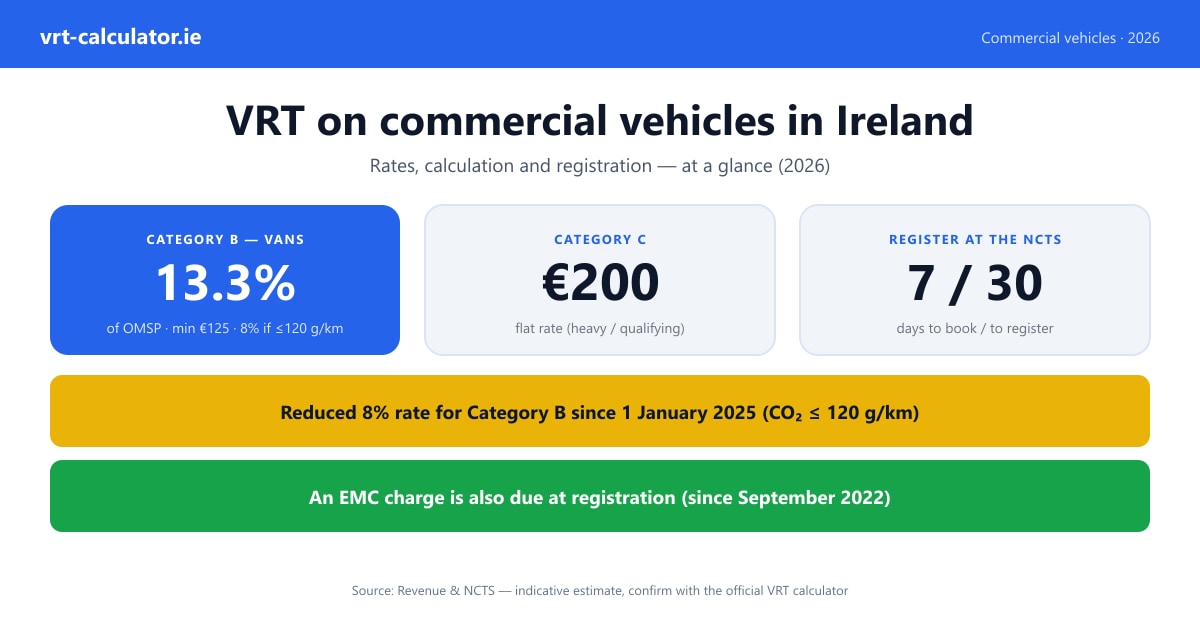
In 2026, Category B commercial vehicles are taxed at 8% of the OMSP when CO₂ emissions are 120 g/km or lower, otherwise 13.3%, with a minimum VRT of €125; Category C is a flat €200. Since Budget 2025 there are now two Category B rates to be aware of, so your van's emissions directly change the bill.
| Category | Vehicle type | VRT rate | Minimum / flat |
|---|---|---|---|
| B | Light commercial N1 < 3.5 t (vans) | 8% of OMSP if CO₂ ≤ 120 g/km, otherwise 13.3% | minimum €125 |
| C | Large/qualifying commercials, buses, tractors | Fixed | €200 flat |
How VRT is calculated: OMSP, CO₂ and NOx
VRT is calculated on the Open Market Selling Price (OMSP) that Revenue assigns your vehicle — not the price you paid — then set by CO₂ band and topped up with a separate NOx levy. Knowing the rate is only half the picture; the amount you actually pay hinges on the value Revenue puts on the vehicle and its emissions.
The OMSP and CO₂ component
The OMSP is Revenue's own valuation of the vehicle on the Irish market. The CO₂ component applies your 8% or 13.3% rate to that OMSP, with the threshold set by the vehicle's WLTP CO₂ figure. The Certificate of Conformity is the document that confirms this CO₂ value.
The NOx levy on top
A NOx levy is then added separately, charged on a per-milligramme basis according to the vehicle's recorded NOx emissions. It is capped at €4,850 for diesel vehicles and €600 for other fuels, so it can add meaningfully to a diesel van's total.
Worked example: VRT on a van
Take a popular panel van — say a Ford Transit Custom or VW Transporter — with an OMSP of €20,000. Its CO₂ figure decides the rate: at an illustrative 110 g/km it qualifies for the reduced 8% Category B rate, so the CO₂ component of VRT is €1,600, before any NOx levy is added. Run the same van at higher emissions and the difference is stark:
- OMSP (set by Revenue): €20,000
- At ≤120 g/km → 8%: €20,000 × 8% = €1,600
- Above 120 g/km → 13.3%: €20,000 × 13.3% = €2,660
- Add the NOx levy based on the van's NOx figure to reach the final amount
Registering and paying VRT at the NCTS
You must book an NCTS appointment within 7 days of the commercial vehicle arriving in Ireland and complete registration within 30 days. Applus Inspection Services examines unregistered vehicles and collects the VRT on Revenue's behalf, so bring the right paperwork to avoid a wasted appointment:
- Proof of identity and proof of address
- Your PPS number
- The Certificate of Conformity and/or V5C
Note that, since September 2022, an EMC charge is also due at the point of registration for vehicles entering the Irish market for the first time.
Commercial vehicle VRT: frequently asked questions
Beyond the rates, the questions importers ask most are about exemptions, paperwork and export.
What vehicles are exempt from VRT in Ireland?
Very few. VRT is due on first registration, but specific reliefs exist — most notably transfer of residence. You need Revenue's approval beforehand and must present the exemption letter at the NCTS, or the full VRT is charged.
What do you need to VRT a van?
You need the vehicle's V5C and/or Certificate of Conformity, proof of identity, proof of address and your PPS number, plus a confirmed NCTS appointment within 7 days of the van arriving.
What is the EMC charge at registration?
Since September 2022, an EMC charge applies at the point of registration for vehicles entering the Irish market for the first time, on top of the VRT itself.
Can you reclaim VRT when exporting a commercial vehicle?
Yes, an export repayment is possible if the vehicle's OMSP is at least €2,000, processed through the NCTS at export.
Published 27 May 2026 by the VRT Calculator Ireland editorial team.