In Ireland, a crew cab usually falls under VRT Category B and is taxed at 13.3% of its Open Market Selling Price (OMSP) — or 8% if CO₂ emissions are 120 g/km or lower — but the wrong cabin layout can push it into the far more expensive passenger category. That single classification decision, made by Revenue at the NCTS inspection, is what separates a manageable tax bill from one that runs into thousands of extra euro. If you are buying or importing a crew cab pickup or van, understanding where yours sits is the most valuable thing you can do before you register it.
This guide walks through how the Vehicle Registration Tax (VRT) applies to a crew cab, what makes it commercial rather than passenger, how to turn your vehicle's value into an actual figure, and the reclassification trap that catches so many buyers.
Is a crew cab a commercial vehicle in Ireland?
A crew cab is treated as a commercial vehicle for VRT only when it has two completely separate compartments — a passenger cabin and a distinct cargo area behind a fixed partition. This is the defining rule in the Revenue VRT Manual Part 1A, which states that a crew cab body type "will only be assigned when the vehicle has two completely separate compartments." When those two compartments are present, Revenue records the vehicle with the BE bodywork code, and it sits in Category B; without them, it drops into the passenger category.
Most crew cabs are built on an EU classification N1 light commercial platform, which is the starting point Revenue looks at. But the paperwork alone does not decide the outcome. To qualify as a commercial crew cab, the vehicle generally must meet these conditions:
- Two separate compartments, with a fixed partition (a proper bulkhead) between the seating area and the load space.
- Up to six seats across two rows, provided those rows are separated from the cargo area.
- A genuine, usable cargo compartment distinct from the passenger space.
A crew cab is a different case from a car-derived van or a jeep-derived van — both single-cab body styles that are usually straightforward Category B vehicles because they have no second row of seats to complicate the layout.
Crew cab van vs double-cab pickup
The term covers two body styles that Revenue can treat differently. A crew cab van is a panel van fitted with a second row of seats and a bulkhead behind them, while a double-cab pickup has two rows of seats in an enclosed cab and an open load bed. Both can qualify for Category B when the passenger and cargo areas are clearly separate units. The risk is the same for both: if the seating and load space read as a single unit, the vehicle is classed as a passenger vehicle regardless of how it is marketed.
What is the VRT rate for crew cabs?
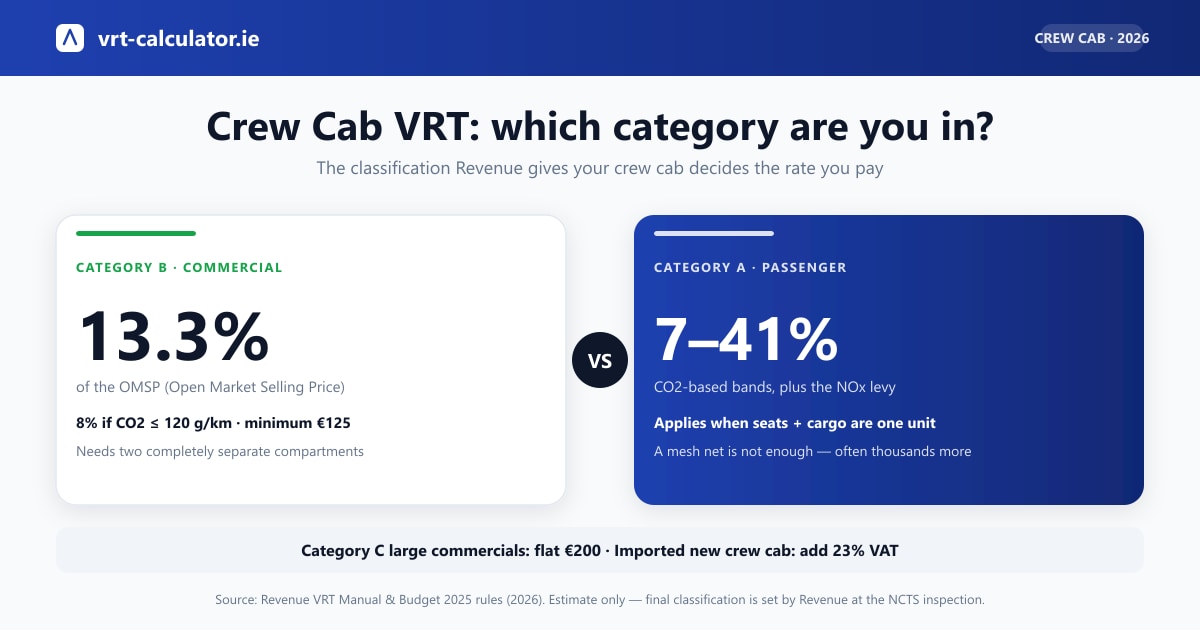
The VRT rate for a crew cab is 13.3% of the OMSP, dropping to 8% when CO₂ emissions are 120 g/km or lower, with a minimum charge of €125 — provided the vehicle keeps its Category B classification. The gap between the commercial rate and the passenger rate is large, which is why the category matters more than any other single factor.
Here is how the three VRT categories compare in 2026:
| Category | Typical crew cab scenario | VRT rate (2026) | Minimum |
|---|---|---|---|
| A (passenger) | Seating and cargo in a single unit | CO₂ bands 7%–41% of OMSP + NOx levy | Varies by band |
| B (commercial) | Two separate compartments, fixed partition | 13.3% of OMSP, or 8% if CO₂ ≤ 120 g/km | €125 |
| C (large commercial) | Under 4 seats, laden mass over 130% of mass in service | Flat €200 | €200 |
Category B (commercial): 13.3% or 8%
Category B is the normal, and most favourable, outcome for a properly built crew cab. Since 1 January 2025, following the Budget 2025 change, a Category B vehicle with CO₂ emissions of 120 g/km or lower pays 8% instead of 13.3%, a deliberate incentive for lower-emission commercials. Everything above that threshold stays at 13.3%, and the charge never falls below €125.
Category A (passenger): the expensive outcome
If Revenue judges the separation inadequate, the crew cab is taxed as a Category A passenger vehicle. That means the CO₂-based bands of 7% to 41% of OMSP, plus a NOx levy on top. For a high-value, higher-emission vehicle, this can easily double or triple the bill compared with the commercial rate.
How to work out the VRT on a crew cab
To estimate VRT on a crew cab, multiply its OMSP by the applicable rate. A crew cab with an OMSP of €20,000 in Category B attracts roughly €2,660 at 13.3%, while the same vehicle pushed into Category A could cost far more once CO₂ bands and the NOx levy are applied. The Open Market Selling Price is Revenue's valuation of the vehicle, not the price you paid, so it is the figure that drives the whole calculation.
The basic method is straightforward:
- Find the OMSP for your exact model, year and specification.
- Confirm the VRT category (B for a compliant crew cab).
- Apply the rate — 13.3%, or 8% if CO₂ is 120 g/km or lower.
- Compare the result against the €125 minimum; you pay whichever is higher.
If you would rather skip the arithmetic, you can run the figures through our VRT calculator to get an instant estimate before you commit to a purchase.
Don't forget VAT on imports
VRT is not always the only charge. When a crew cab is a new means of transport — under six months old or with fewer than 6,000 km — 23% VAT can apply on top of the VRT when you bring it into the State. That is a substantial addition, so factor it into any imported-crew-cab budget before you commit.
The reclassification trap: staying in Category B
The single biggest cost risk with a crew cab is reclassification. If the partition between seats and cargo is missing or inadequate, Revenue taxes the vehicle as a Category A passenger car — often thousands of euro more. Crucially, classification is based on the physical configuration on the day of inspection, not on the logbook or the way the vehicle was sold.
Keep these points in mind before you present the vehicle:
- A mesh net or flexible cover is not enough — Revenue requires a solid, fixed partition to accept two separate compartments.
- Six seats are fine for Category B, but only if the rear seating is genuinely separated from the load area.
- Book your NCTS appointment within 7 days of the vehicle arriving and complete registration within 30 days.
- If the model has no EU type-approval, you may need an Individual Vehicle Approval from the NSAI (National Standards Authority of Ireland) before it can be registered.
- If you convert a van to a crew cab, the seat change must be reflected on the logbook, which typically needs sign-off from a Suitably Qualified Individual (SQI).
Once registered as a commercial vehicle, the crew cab is also subject to an annual CVRT (Commercial Vehicle Roadworthiness Test) from its first anniversary, which is separate from VRT but part of running the vehicle legally.
Crew cab VRT: frequently asked questions
No, crew cabs are not exempt from VRT — but the right classification keeps the bill low. The questions below cover the practical points that come up once the basics are clear.
Are crew cabs exempt from VRT?
No. A crew cab used for ordinary business or private purposes is fully liable for VRT. The narrow VRT exemptions and reliefs in Ireland (such as transfer of residence, in limited circumstances) apply to the owner's situation, not to the crew cab body style itself.
What counts as a proper partition for a Category B crew cab?
Revenue accepts a solid, fixed bulkhead — typically a steel or ply panel permanently secured across the full width and height between the seats and the load space. A mesh net, cargo blind or soft cover does not meet the standard, so it is worth confirming the panel is bolted in and immovable before your inspection.
Do I pay VAT as well as VRT on an imported crew cab?
You can. If the crew cab is a new means of transport — under six months old or under 6,000 km — 23% VAT is chargeable in addition to VRT when it is registered in the State. Older, higher-mileage vehicles brought from within the EU are generally not caught by this VAT charge, but VRT still applies.
Published 16 July 2026 by the VRT Calculator Ireland editorial team.