OMSP stands for Open Market Selling Price — and it is the single number that decides most of your VRT bill in Ireland. When you import a car and register it, Revenue does not tax you on the price you paid abroad. Instead, it works out what that vehicle would sell for, fully taxed, on the Irish retail market, and uses that figure as the base for your Vehicle Registration Tax (VRT).
That distinction catches a lot of importers out. You might buy a car in the UK for €18,000, feel pleased with the deal, and then discover that Revenue's OMSP sits well above your invoice — pushing the VRT higher than you budgeted for. Understanding how the OMSP is set is the best way to avoid that surprise, estimate your bill before you commit, and challenge a valuation that looks too high.
What is the OMSP (Open Market Selling Price)?
The OMSP is Revenue's estimate of the price a vehicle would sell for, tax included, on the open Irish retail market. It is not the price you paid, not a trade or auction figure, and not a private-sale price — it is an assessed retail value, and it already contains every tax that would apply to a sale in Ireland, including VRT itself.
According to Revenue's own guidance on Assessing the value (revenue.ie, March 2026), this OMSP is the value used to calculate the VRT due on a vehicle. For a used car, the VRT Manual Part 08 sets out the principle clearly: Revenue determines the market price of the model when new, then applies a rate of depreciation to arrive at the current OMSP.
In practical terms, the OMSP represents:
- The tax-inclusive retail price a dealer would realistically ask for that exact model in Ireland today.
- An estimated value, not a record of any single real transaction.
- The legal tax base for the VRT calculation on your vehicle.
Because it is an estimate built from data rather than your paperwork, two people importing identical cars can end up with the same OMSP even if they paid very different amounts.
How OMSP and VRT are connected
Your VRT is calculated as a percentage of the OMSP, so a higher OMSP almost always means a higher VRT bill. Now that you know what the OMSP is, the next question is how that single value turns into the actual tax you pay. The link runs through two separate charges: the CO2 component and the NOx levy.
The CO2 component: a percentage of the OMSP
The main part of your VRT — the CO2 component — is applied as a percentage of the OMSP, and the percentage depends on the vehicle's CO2 emissions. Lower-emission cars sit in lower percentage bands; higher-emission cars sit in higher ones. Multiply the OMSP by that CO2 percentage and you have the core of your bill. The exact bands and rates are set by Revenue and revised periodically, so always confirm the current figures on Revenue's official VRT calculator rather than relying on a number you saw on a forum.
The NOx levy: an add-on, not part of the OMSP
The NOx levy is a separate charge added on top of the VRT, and it is not a percentage of the OMSP. It is calculated from the vehicle's nitrogen oxide (NOx) emissions, measured in milligrams per kilometre, with the charge rising as emissions increase. Because it is based on emissions rather than value, a cheap older diesel can carry a surprisingly large NOx levy. Treat it as a distinct line item: OMSP drives the CO2 charge, while emissions data drives the NOx levy.
How Revenue determines the OMSP
Revenue works out the OMSP by taking a model's original price when new and applying a depreciation rate based on age, mileage, condition and specification. Because the OMSP drives the whole bill, it is worth understanding exactly how Revenue arrives at that figure — and where the system leaves room for judgement.
Original market price and depreciation
The starting point is the price the model commanded when new on the Irish market. Revenue then applies a depreciation rate appropriate to that model and its age, as described in the VRT Manual Part 08: the OMSP of a used vehicle is the market price when new reduced by depreciation for that particular model. Different models hold their value differently, so the curve is not one-size-fits-all — a sought-after model depreciates more slowly, keeping its OMSP higher for longer.
One frustration for importers is that Ireland has no public, official used-car price guide equivalent to the UK's Glass's Guide. As motoring expert Neil Briscoe noted for CompleteCar, this means Revenue can set a value it sees fit, which makes the system feel less transparent than buyers would like.
Adjustments: mileage, condition, trim and options
On top of depreciation, Revenue adjusts the OMSP for the specifics of your actual car. Higher mileage typically lowers the OMSP; lower mileage, strong condition, a premium trim level and desirable factory options push it up. These are exactly the details worth documenting, because each one is also a lever you can use later if you need to challenge the valuation.
| Factor | Effect on OMSP | Useful evidence if you challenge it |
|---|---|---|
| Mileage | Higher mileage lowers it | Verified odometer reading, service history |
| Condition | Poor condition lowers it | Dated photos, repair quotes/invoices |
| Trim / spec | Higher trim raises it | Manufacturer spec sheet, build data |
| Optional extras | Desirable options raise it | Original order/invoice listing options |
| Model demand | Strong demand raises it | Irish retail listings for the same model |
Why your OMSP is often higher than the price you paid
The OMSP reflects Irish retail value with all taxes included, which is why it is frequently higher than the price you paid for the same car abroad. If you have just bought a car in the UK, you have probably noticed that Revenue's OMSP does not match your invoice — and that is by design. The OMSP measures what the car would fetch at retail in Ireland, a generally pricier market, with Irish taxes baked in.
A foreign invoice, by contrast, may reflect a private deal, a dealer discount, a weaker market, or simply a tax regime where the price excludes Irish duties. None of that changes the OMSP.
The lesson is simple: never assume your invoice equals your tax base.
How to estimate the OMSP before you import a car
You can estimate the OMSP yourself before buying by using Revenue's official VRT calculator, which returns the OMSP and the VRT due for most models already registered in Ireland. Knowing why the OMSP can be high is useful, but the real protection against a surprise bill is to estimate it before you commit to a purchase.
Step-by-step with Revenue's VRT calculator
Use Revenue's calculator (linked from the Assessing the value page on revenue.ie) and work through it carefully:
- Select the exact make, model, version and fuel type of the car you intend to buy.
- Enter the year and registration date so depreciation is applied correctly.
- Input the mileage you expect at the time of registration, not today's reading.
- Read off the returned OMSP and the estimated VRT (CO2 component plus NOx levy).
- Repeat for a couple of nearby trims to see how spec moves the figure.
When the model isn't in the calculator
The calculator only knows models that have already been VRT'd in Ireland. If you are importing a UK-spec car that has never been registered here — a real scenario raised on CompleteCar about a top-spec Kia Niro — the system may have no comparable entry, and Revenue may only confirm the OMSP after you register. In that case, gather Irish retail listings for the closest equivalent model and contact Revenue via MyEnquiries before committing, so you are not buying blind.
How to challenge an OMSP you think is too high
If you believe the OMSP is too high, you can ask Revenue to review it and, if that fails, appeal to the independent Tax Appeals Commission. Even with a careful pre-purchase estimate, Revenue's final OMSP can still come in higher than expected — and you do have the right to challenge it. Go in prepared, though: the bar for overturning a valuation is high.
Step 1 to 3: from MyEnquiries to the Tax Appeals Commission
Work through the process in order, escalating only if each stage fails:
- Ask for clarification and a review. Use MyEnquiries or the contact details in your VRT decision to query the OMSP and request a review.
- Submit a formal written appeal to Revenue with clearly labelled evidence supporting a lower value.
- Appeal to the Tax Appeals Commission (TAC) if Revenue's internal review does not resolve it — the TAC is the independent body that adjudicates disputes against Revenue.
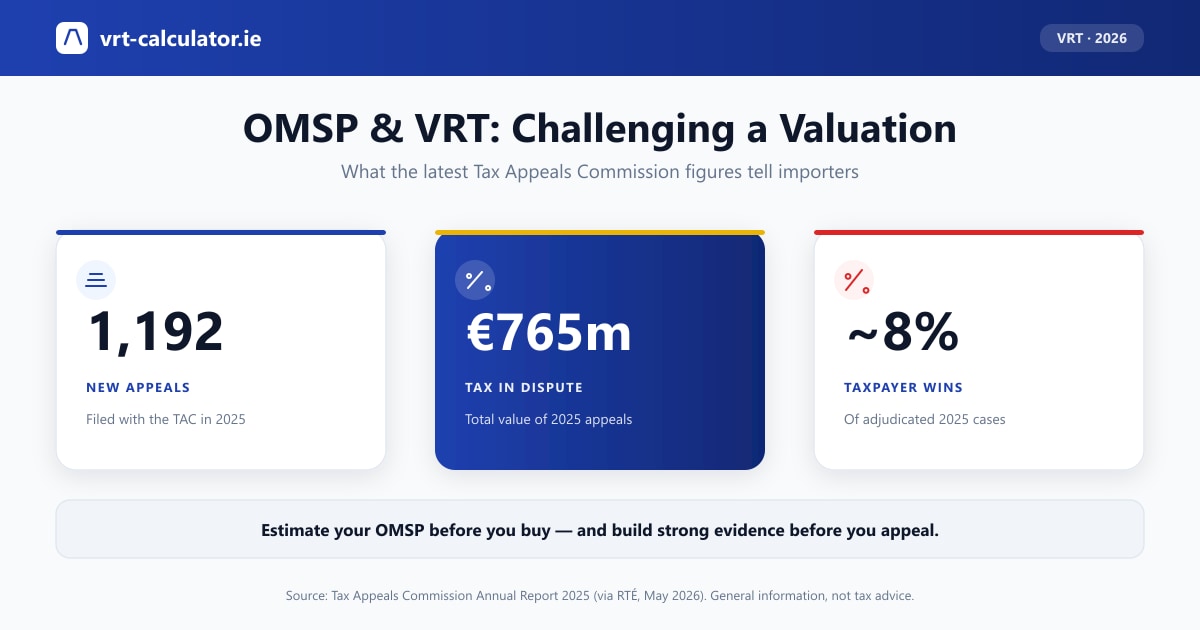
Set your expectations realistically. The TAC received 1,192 new appeals worth €765 million in 2025 (Tax Appeals Commission annual report, via RTÉ, 19 May 2026), and across appeals that were adjudicated, taxpayers succeeded in only around 8% of cases (TAC annual report, 2025). A weak appeal rarely wins.
Evidence that helps lower an OMSP
A credible challenge is built on specific, comparable evidence — not opinion. The strongest material includes:
- Irish retail listings for the same model, trim and similar mileage, showing lower asking prices.
- Dealer invoices evidencing genuine local market values or discounts.
- An independent valuation from a recognised valuer.
- Dated photos and repair quotes proving condition issues, and a service history verifying mileage.
Label your files clearly, state the OMSP you believe is fair, and explain exactly why.
Frequently asked questions about OMSP
OMSP raises a few recurring questions for importers — here are clear answers to the most common ones. Beyond the core mechanics, a handful of practical questions come up again and again from people importing a car.
Does the OMSP include VRT?
Yes. The OMSP is a tax-inclusive Irish retail value, and the VRT is already contained within it. That is why you cannot simply take the OMSP and add VRT on top — the VRT is instead extracted as a percentage of that all-in figure. It is one reason the OMSP feels high compared with a tax-exclusive foreign price.
What is the NOx VRT charge?
The NOx charge is an additional levy added to your VRT, calculated from the vehicle's nitrogen oxide emissions in milligrams per kilometre. It is separate from the OMSP-based CO2 component and rises with emissions, so older or higher-emission diesels can attract a sizeable NOx levy even when the car itself is cheap.
Can the OMSP be reduced after the car is registered?
Yes, but only by requesting a review and, if needed, formally appealing — with solid evidence such as comparables, an independent valuation and condition documentation. Success is far from guaranteed, as the low TAC win rate for taxpayers shows, so the strongest position is to assemble your evidence before you register, not after.
Does OMSP always mean Open Market Selling Price?
In any Irish VRT context, yes — OMSP means Open Market Selling Price. Outside that context the same letters are used for unrelated things (for example, a US university's Osteopathic Medical Scholars Program), but those have nothing to do with car tax in Ireland.
Published 15 June 2026 by the VRT Calculator Ireland editorial team — specialists in VRT and vehicle importation in Ireland. Verified against Revenue.ie published rules.