If you have just imported a car, the form you almost certainly need is the VRTVPD2 — and this guide shows you exactly where it fits in the full registration timeline. A VRT form is the vehicle purchase details declaration you complete and hand in, in person, at an NCTS centre so the Revenue Commissioners can register your imported vehicle and charge the correct Vehicle Registration Tax. Private importers use the VRTVPD2; authorised motor traders holding a TAN use the VRTVPD1. Both are free to download from revenue.ie, and both are only one link in a longer chain.
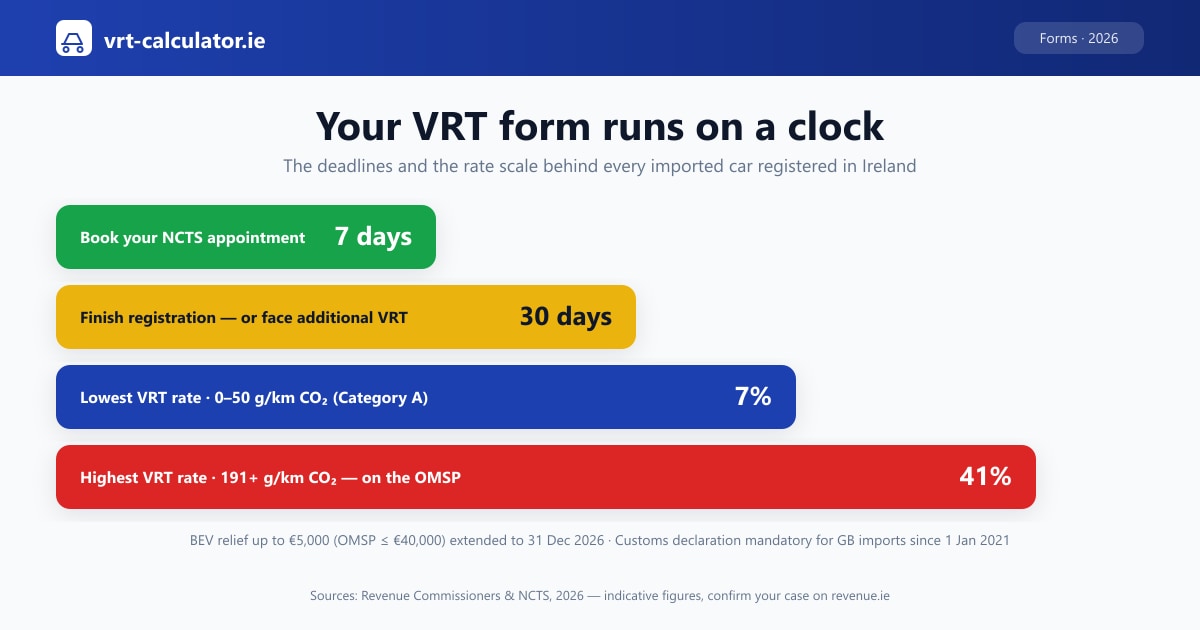
That chain is what actually matters. The form on its own does nothing until the steps around it are done in the right order: the customs declaration comes first, the NCTS booking has a 7-day clock on it, and the whole registration must be finished within 30 days of the vehicle entering the State (NCTS/Revenue, 2026). The timeline further down explains exactly what that deadline means in practice. So rather than treat the PDF as the destination, this page walks you through the entire journey — port to paid VRT — and drops the form into its proper slot along the way.
Which VRT form do you need — and where to download it
Two forms cover almost every case — the personal-use VRTVPD2 and the trade-only VRTVPD1 — and both are free from revenue.ie. Before we walk through the whole process, let's settle the question that trips most people up: which one applies to you, and where the official copy lives.
The quick answer: VRTVPD2 vs VRTVPD1
Roughly nine in ten people reading this need the VRTVPD2. If you bought a car for your own use and you are registering it in your own name, that is your form — full stop. The VRTVPD1 is not a lighter or heavier version of the same thing; it is a completely separate declaration reserved for authorised motor traders operating under a Trader Account Number (TAN). Unless you run a registered dealership and hold a TAN, you will never touch the VRTVPD1. Getting this right first saves you downloading, printing and filling in the wrong document the night before your appointment.
Every VRT form and its official download link
Beyond the two main forms, a handful of situations call for a different document or a different channel entirely. The table below maps your situation to the exact form, the official Revenue source, and where it goes. Every link points to Revenue's own PDF — nothing here is a hosted or altered copy.
| Your situation | Form you need | Where to get it (official) | Submitted to |
|---|---|---|---|
| Private individual importing a car | VRTVPD2 | form-vrtvpd2.pdf on revenue.ie | NCTS, in person |
| Motor trader / TAN holder | VRTVPD1 | form-vrtvpd1.pdf on revenue.ie | NCTS |
| Vehicle not in the Revenue database (needs a manual estimate) | VRT Estimate form | revenue.ie | MyEnquiries |
| Transferring residence to Ireland | Transfer of Residence (TOR) | revenue.ie | MyEnquiries |
| Claiming an exemption (diplomatic, disabled driver, charity) | Specific exemption form | revenue.ie | MyEnquiries |
| Buying a car already registered from an Irish dealer | No VRT form — motor tax only (RF100) | gov.ie / motortax.ie | Local motor tax office |
VRT form vs RF100: don't confuse the two
The RF100 is not a VRT form and never was. It is the motor tax application you use after a vehicle is registered, to tax it for the road — a recurring annual charge, not the one-off registration levy. Revenue's VRT forms register the car and set the tax band; the RF100 keeps it road-legal once that is done. If you bought from an Irish dealer, the car is already registered, so there is no VRTVPD2 in your future at all — just the RF100 for motor tax, available through gov.ie or motortax.ie.
The full VRT timeline: from the port to your VRT payment
The VRT form is step four of a six-step chain — customs declaration first, then the form, then booking the NCTS, the inspection, and finally payment — and skipping the order is what gets people stuck. Now that you know which form to grab, the real question is when to use it, because the form is useless until the steps before it are done.
Step 1 — Customs declaration (AIS, EORI, MRN) before anything else
For any car imported from Great Britain, a customs declaration has been mandatory since 1 January 2021, when Brexit turned GB into a third country for import purposes. You (or an agent) file the declaration through Revenue's Automated Import System (AIS), which means you first need an EORI number — a customs identifier you register for through ROS. When the declaration clears, Revenue issues an MRN (Movement Reference Number), sometimes called the customs declaration number. That MRN, together with its item number, is the key that unlocks everything after it. Vehicles arriving from Northern Ireland may follow different customs rules depending on the car's history and when it was first registered, so check your specific case before assuming no declaration is needed.
Step 2 — Book your NCTS appointment within 7 days
You cannot book your NCTS appointment until the customs declaration is complete and you hold the MRN — the booking system asks for it. Once you have it, the clock is tight: the appointment must be booked within 7 days of the vehicle entering the State (NCTS/Revenue, 2026). You book through the NCTS VRT service online or by phone, choosing a centre and a slot. Book early, because popular centres fill up and a missed 7-day window puts your later 30-day registration deadline at risk.
Step 3 — Complete and sign your VRT form (VRTVPD2)
With the appointment secured, this is where the VRTVPD2 enters the picture. Download it from revenue.ie, print it, complete it and sign it, then keep it flat and clean ready to hand over on the day alongside your document pack. Exactly how to fill each field so it clears the counter is covered in the filling-in section below. The form captures who you are and what the vehicle is; the accompanying papers prove it.
Step 4 — Gather the accompanying documents
The form alone is never enough. The NCTS agent checks a supporting file just as carefully as the form itself, and a missing document sends you home to rebook. At minimum you will need the customs MRN, your PPSN, the original purchase invoice, proof of an Irish address and the vehicle's identity papers. The full pack, including the extras for new and vintage vehicles, is laid out in the checklist further down.
Steps 5 and 6 — Inspection at the NCTS, then paying the VRT
At the appointment the NCTS carries out a VRT inspection: an examiner checks the VIN against your paperwork, confirms the statistical code that classifies the vehicle, and verifies the details on your form. Once the vehicle is identified, the system calculates your VRT as the OMSP multiplied by the appropriate CO₂-based rate, and you pay on the spot by card. When payment clears, the car is registered, you are issued your Irish registration number, and you can order your registration plates. Registration must be complete within 30 days of the vehicle entering the State, or you face additional VRT and the offence of driving an unregistered vehicle (Revenue, 2026).
A real import from start to finish: one driver's complete file
Here is exactly how the timeline plays out in practice: a private buyer who brings a used car back from Britain completes her registration in under two weeks by doing each step in order. Timelines are easy to read but harder to picture, so let's follow one real-world file from purchase to paid VRT.
Filling in the VRTVPD2 without getting rejected
A VRT form is refused at the counter for boring, avoidable reasons — not printing in BLOCK LETTERS, forgetting the ink signature, or leaving the VIN and statistical code blank. In the example above Aoife's form went through first time; here is precisely how to fill yours so it does the same.
The fields that must be exactly right
A handful of fields carry the whole form, and getting any of them wrong stalls the inspection. Copy them straight from your source documents rather than from memory, and double-check each character.
- VIN / chassis number — transcribe it exactly from the V5C or foreign registration document; a single wrong digit breaks the match against the vehicle.
- PPSN — your Personal Public Service Number, which ties the registration to you; the car cannot be registered in your name without it.
- Vehicle details — make, model, engine and body type, consistent with the registration document.
- Date of purchase and purchase details — must line up with the invoice you hand over.
Write every entry in clear block capitals, keep the ink dark, and do not overwrite or scribble corrections — start a fresh form if you make a mistake.
Counter mistakes that get the form rejected
Most rejections have nothing to do with the car and everything to do with how the paperwork was prepared. These are the ones NCTS staff see again and again:
Fix these before you leave home and the counter becomes a formality rather than a hurdle.
The documents that must travel with your form
Your VRT form is only accepted when it arrives with a complete document pack: the customs MRN, your PPSN, the purchase invoice, proof of an Irish address and the vehicle's identity papers. The form and its fields are sorted, but the NCTS agent checks the supporting file just as closely — so here is the full pack.
The core checklist everyone needs
Every private importer, whatever the car, brings the same foundation set. Tick each one off before you go:
- ☐ Customs MRN (and item number) from your AIS declaration
- ☐ PPSN — proof of your Personal Public Service Number
- ☐ Original purchase invoice or bill of sale
- ☐ Foreign registration document (for a UK car, the V5C)
- ☐ Proof of an Irish address — a recent utility bill or bank statement (a TV licence is not accepted)
- ☐ Photo ID to confirm your identity
- ☐ Your completed, signed VRTVPD2
Extra papers for new, used or vintage vehicles
Depending on the vehicle's age and origin, one or two additional documents sit on top of the core set.
- New vehicles need a valid Certificate of Conformity (CoC) or electronic e-CoC entered into the Revenue system before registration; it confirms the car meets EU type-approval standards, and for certain non-EU imports certification by the National Standards Authority of Ireland (NSAI) may be required.
- Used EU imports should carry their foreign roadworthiness certificate where one exists, alongside the registration document.
- Vintage vehicles over 30 years old are handled as a special category and typically need a supporting club declaration confirming the vehicle's age and identity, in addition to the standard VRTVPD2 (Revenue/vrt.ie, 2026).
Estimate your VRT before the appointment
Work out your VRT before you walk into the NCTS: it is calculated as the vehicle's OMSP multiplied by a CO₂-based rate of 7% to 41%, so a quick estimate tells you what to expect at the till. With the form filled and the documents packed, the last thing to do before your slot is know how much you will actually pay.
How the VRT figure is built
The formula is simple in shape: VRT = OMSP × CO₂-based rate. The Open Market Selling Price is Revenue's view of what the car is worth on the Irish market, and the rate is set by emissions — from 7% for the cleanest cars (0–50 g/km CO₂) up to 41% for the highest emitters (191+ g/km) in Category A (Revenue, 2026). If you are importing a battery electric vehicle, there is relief of up to €5,000 where the OMSP is €40,000 or less (tapering to zero at €50,000), extended to 31 December 2026 under Budget 2026.
Use the calculator (and why the statistical code matters)
Rather than guess, run the numbers through our VRT calculator to get an indicative figure before you go. The statistical code is what sharpens the estimate: it pins your exact variant so the OMSP reflects the real car rather than a rough average. If the vehicle is not in the Revenue database at all, you use the VRT Estimate form through MyEnquiries to have Revenue set a value manually. Treat any figure you get as indicative — the final, binding calculation is the one performed at the NCTS.
VRT form FAQ
The questions below cover the edge cases that trip up importers most: attending on someone's behalf, dealer purchases, rejected forms, Northern Ireland and vintage vehicles. Once the main file is ready, a few recurring questions are left — here are the short answers.
Can someone else present my VRT form at the NCTS for me?
Yes. You do not have to attend in person — a family member, friend or an appointed agent can present the VRTVPD2 and the document pack at the NCTS on your behalf, as long as the form is completed and signed by you and every supporting document is in order. The person attending should carry their own photo ID as well. The car itself must still be brought to the centre, because the examiner has to check the VIN and the statistical code against the paperwork during the inspection.
Do I need a VRT form if I buy from an Irish dealer?
No. A car bought from an Irish dealer is already registered in the State, so there is no VRT to pay and no VRTVPD2 to file. All you deal with is motor tax via the RF100. VRT forms only come into play when you are the one registering an imported vehicle.
What if my VRT form is rejected at the NCTS centre?
You correct the problem and re-present the file — usually rebooking a fresh appointment. The catch is that the 30-day registration deadline still applies: a rejection does not pause the clock, so fix the flagged issue (missing MRN, wrong signature, mismatched invoice) fast and rebook the earliest slot.
Is the form different for a Northern Ireland import?
The form is the same VRTVPD2 for a private buyer. What changes is the customs side: whether a declaration is required for a Northern Ireland vehicle depends on the car's origin and history, so confirm your specific case with Revenue before booking rather than assuming.
Do vintage vehicles over 30 years need a special form?
You still use the VRTVPD2, but vehicles over 30 years are treated as a special category and generally need a supporting club declaration to confirm age and identity alongside the standard document pack.
Published on July 6, 2026 by the vrt-calculator.ie team, specialists in VRT estimation and registration in Ireland, aligned with current Revenue and NCTS procedures.