A VRT statistical code is a unique number — usually 8 digits — that Revenue uses to identify the exact make, model and version of a vehicle and link it to an Open Market Selling Price (OMSP) and a VRT estimate. If you are importing a car into Ireland and the calculator is asking for a "statistical code" you have never heard of, you are in the right place. This guide explains exactly what the code is, where to get it in a few minutes, and how it decides the amount of Vehicle Registration Tax you will owe. It is written for drivers bringing a vehicle in from the UK or Japan, with the official Revenue and ROS sources to back everything up. To see your own code, run your details through our VRT calculator.
What is a VRT statistical code?
A VRT statistical code uniquely identifies the make, model, version and variant of a vehicle, with an individual OMSP and VRT estimate determined by Revenue for that exact vehicle. It is a numeric reference — typically eight digits, such as 40287323 — and no two specs share the same code.
Think of it as the key that opens one specific record in Revenue's valuation database. Once Revenue knows the code, it knows the precise vehicle and the value attached to it.
What the code actually tells Revenue
The code maps your vehicle to a single entry that already holds everything Revenue needs to tax it. Behind one code sits a fixed set of attributes:
- The make, model, version and variant (so a base trim and a sport trim differ).
- The current OMSP that Revenue has set for that vehicle.
- The data points used to calculate VRT, including CO₂ emissions and category.
That is why entering a valid code into the VRT calculator auto-populates your vehicle details: the code already points to all of it.
Where the code is (and isn't) shown
The statistical code is not printed on your logbook, V5C or registration document. Many importers waste time searching paperwork for it. It does not live there. Instead, the code is produced on demand by the VRT calculator. You generate it by running a calculation — which is exactly what the next section covers.
How to find your VRT statistical code
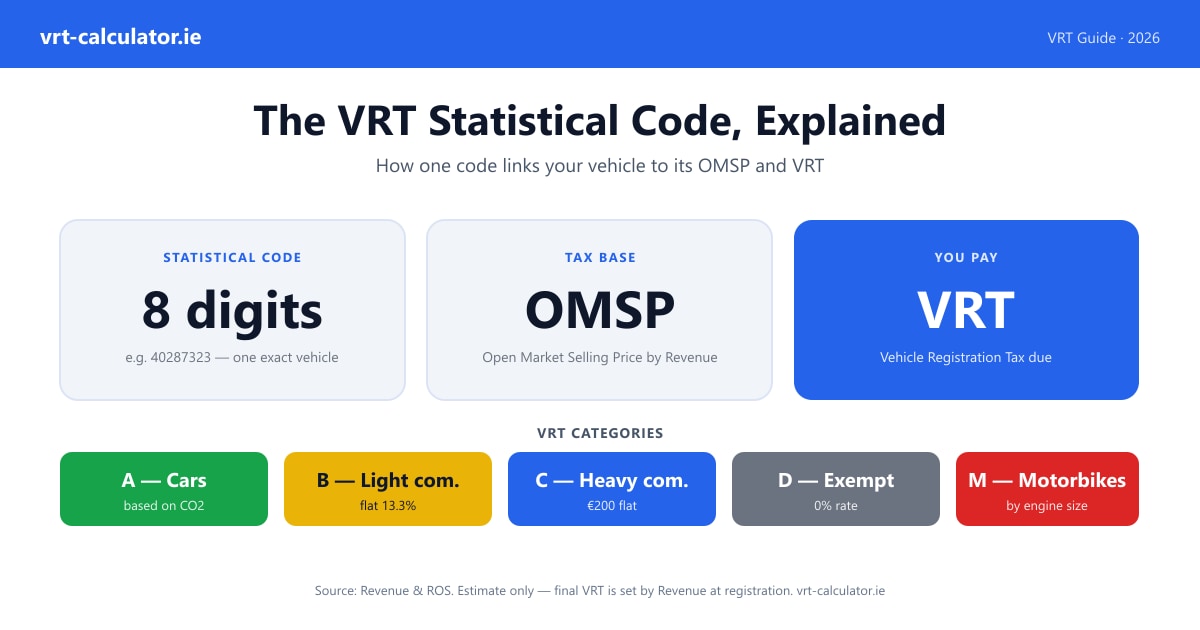
You get a VRT statistical code by running a VRT calculation: once Revenue's database matches your vehicle, the code is generated automatically and shown alongside your VRT estimate. There is no public list of codes to look up — they are generated on the fly from your vehicle's exact characteristics (source: Revenue / ROS). So the only way to get yours is to feed in the right details.
What details you need before you start
Have the vehicle's key specifications to hand before you begin, so the database can find an exact match. Gather:
- The EU classification (M1 passenger, N1 light commercial).
- Make and model.
- Month and year of first registration.
- Fuel type and engine size (cc).
- CO₂ emissions (WLTP figure where available).
You can usually find these on the seller's listing, the UK V5C or a vehicle history report.
Step-by-step: generating the code
Run the calculation with the details above and the code appears at the end. Follow these steps:
- Open a VRT calculator connected to Revenue's database (Revenue's own VRT enquiry on ROS, or our calculator on vrt-calculator.ie).
- Choose "Search by vehicle details" rather than "Search by statistical code".
- Enter the EU classification, make, model, registration date, fuel type and emissions.
- Submit the form so the system matches your vehicle against Revenue's database.
- Read the result: the statistical code is displayed with your OMSP and estimated VRT. Note it down — you can paste it into "Search by statistical code" next time to skip straight to the result.
How the statistical code sets your OMSP and VRT
The statistical code matters because it locks your vehicle to a specific OMSP (Open Market Selling Price), and that OMSP is the value Revenue taxes to calculate your VRT. Once you have the code, the real question is what it does to the amount you pay — and that comes down to the OMSP. For Category A passenger cars, VRT is based on CO₂ emissions; a NOx levy is added on top depending on the vehicle. The chain runs code → OMSP → applicable rate → VRT due.
Worked example: from code to VRT
The clearest way to see this is a sample report. The figures below are illustrative, based on a typical Revenue calculation:
| Field | Value |
|---|---|
| Statistical code | 40287323 |
| Make / Model | BMW / 320 (F30) |
| OMSP (set by Revenue) | ~€13,691 |
| CO₂ emissions | 109 g/km |
| VRT rate | 16% |
| Estimated VRT | ~€2,190 |
The code is what ties this specific BMW to that specific OMSP. Change the code, and every figure below it can change too.
Why two similar cars can have different codes
What to do if your statistical code can't be found
If the calculator returns no statistical code, it usually means Revenue's database has no exact match for your vehicle — and you can still calculate VRT by entering the full vehicle details manually. Most cars return a code instantly, but rare imports and older models sometimes don't. Here is how to handle it:
- Use "Search by vehicle details" and complete every field, including EU classification, so VRT can be estimated without a code.
- Double-check the make, model, date and emissions — a small mismatch can block the match.
- Note that if CO₂ emissions have not been provided to Revenue for that model, VRT is calculated at the default (highest) rate (source: ROS VRT calculator).
- For confirmation on an unusual vehicle, contact Revenue directly; the official code is set by Revenue at registration.
Frequently asked questions about the VRT statistical code
These are the questions Irish car importers ask most often about the statistical code, beyond how to find it and what it means.
Is the statistical code the same as my registration number or VIN?
No. Your registration number is the plate, and your VIN is the chassis number stamped on the vehicle. The statistical code is a separate Revenue reference used only to value and tax the vehicle. The same car has all three, and they are not interchangeable.
Will two cars of the same model have the same statistical code?
Not necessarily. The code reflects the version and variant, not just the model name. Two cars sharing a model badge but differing in engine, trim or year of first registration can have different codes — and therefore different OMSP values.
How long is a VRT statistical code valid?
The code keeps identifying the same vehicle, but the OMSP linked to it is revised by Revenue periodically. So a code stays valid, yet the VRT it returns can change over time as the market value is updated. Always re-run the calculation close to your registration date.
Do motorcycles and vans also have a statistical code?
Yes, provided the vehicle exists in Revenue's database. Statistical codes cover passenger cars (Category A), light commercials (Category B), and Category M motorcycles alike. The category affects how VRT is charged, but the code system works the same way across them.
Published 5 June 2026 by the VRT Calculator Ireland editorial team, specialists in Irish vehicle registration tax. Verified against Revenue.ie and ROS primary sources.