Motorcycle VRT in Ireland costs €2 per cc up to 350cc, then €1 per cc for every cc above that — based entirely on engine size, not purchase price. A standard 600cc sport bike carries a base VRT of €950 before any age reduction. If that bike is three to four years old, you pay just €475. All figures come from Revenue Commissioners official guidance, valid as of 2026. Use the official Revenue VRT calculator to get a precise estimate for your specific motorcycle.
How VRT is calculated on a motorcycle in Ireland
Motorcycle VRT in Ireland depends solely on the engine's cubic capacity — not purchase price, not CO₂ emissions — which makes it simpler to estimate than car VRT. Revenue Commissioners classify motorcycles as Category M vehicles (EU categories L1 to L7), and the tax is applied using a two-tier rate.
VRT rates by engine size (2026 table)
The formula: multiply the first 350cc by €2, then multiply any remaining cc by €1. Add both figures together for your base VRT.
| Engine size | Rate | Example bike | Base VRT |
|---|---|---|---|
| Up to 350cc | €2 per cc | Yamaha MT-125 (125cc) | €250 |
| Up to 350cc | €2 per cc | Royal Enfield Meteor (293cc) | €586 |
| 351cc–650cc | €2 up to 350 + €1 above | Kawasaki Z650 (649cc) | €999 |
| 651cc–1000cc | €2 up to 350 + €1 above | Yamaha YZF-R1 (998cc) | €1,348 |
Source: Revenue Commissioners, 2026 — revenue.ie/en/vrt/calculating-vrt/applying-tax.aspx.
How motorcycle VRT differs from car VRT
Cars in Ireland are taxed under Category A, using a complex formula based on the Open Market Selling Price (OMSP) and CO₂/NOx emissions — which means two identical-looking cars can attract very different VRT bills. Motorcycles use none of this: the calculation is purely engine-size-driven, transparent and predictable.
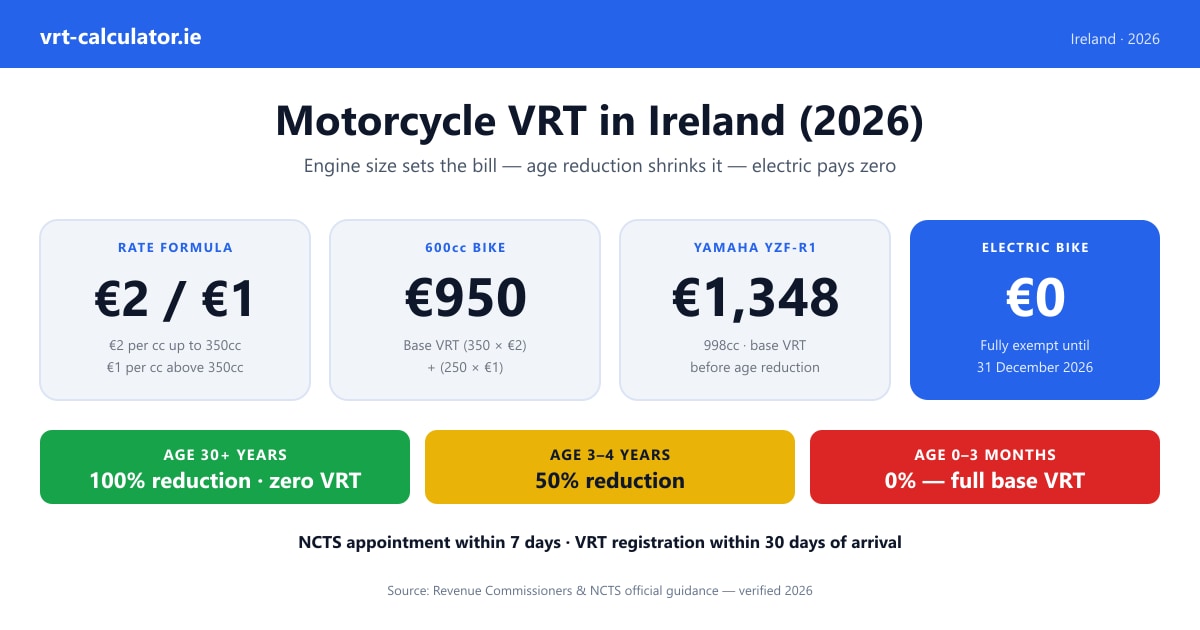
Age reduction: how a motorcycle's age lowers your VRT bill
Once you know the base VRT, the next step is to apply the age reduction — which can dramatically lower the amount you actually owe at registration. The older the motorcycle, the less VRT you pay — and a bike over 30 years old is completely exempt, with 100% of the VRT waived. This makes importing classic bikes from the UK or European markets significantly more attractive: you still attend the NCTS for inspection and pay the EMC charge, but the VRT bill itself disappears.
Revenue Commissioners publish a fixed age reduction table (valid as of 2026):
| Age of motorcycle | VRT reduction |
|---|---|
| 3 months to 1 year | 10% |
| 1 to 2 years | 20% |
| 2 to 3 years | 40% |
| 3 to 4 years | 50% |
| 4 to 5 years | 60% |
| 5 to 7 years | 70% |
| 7 to 10 years | 80% |
| 10 to 30 years | 90% |
| Over 30 years | 100% (zero VRT) |
Source: Revenue Commissioners, 2026.
Worked example: same bike, different ages
To make this concrete, take a Kawasaki Z650 (649cc) with a base VRT of €999:
| Bike age | Reduction | Amount saved | Final VRT |
|---|---|---|---|
| New (0–3 months) | 0% | €0 | €999 |
| 3–4 years old | 50% | €499.50 | €499.50 |
| 7–10 years old | 80% | €799.20 | €199.80 |
Electric motorcycles and e-bikes: VRT exemption until end of 2026
If you're considering an electric rather than a petrol motorcycle, the VRT picture looks very different. Electric motorcycles are fully exempt from VRT in Ireland — you pay €0 at registration, making the upfront cost of switching to electric significantly lower.
This exemption applies to electric motorcycles registered in Ireland until 31 December 2026, per Revenue Commissioners' official guidance (revenue.ie/en/vrt/calculating-vrt/electric-vehicles.aspx). Standard pedal e-bikes (no motor, or motor below pedal-assist threshold) are not subject to VRT and fall outside the Category M classification. Plug-in electric motorcycles with a type-approved motor are the ones that benefit from the exemption — always verify your specific model's category with Revenue before purchasing.
Importing a motorcycle to Ireland: step-by-step VRT process
Knowing how much VRT you'll pay is only the first step — understanding the registration process ensures you avoid penalties and complete the import without delays. When you import a motorcycle to Ireland — whether from the UK or Europe — you must book an NCTS inspection within 7 days of arrival and complete VRT registration within 30 days (Revenue Commissioners / NCTS, 2026).
The NCTS (National Car Testing Service), operated by Applus Inspection Services Ireland Ltd on behalf of Revenue, carries out the inspection and collects the VRT on the day.
Step-by-step process:
- Estimate your VRT using the official Revenue calculator at ros.ie before purchasing.
- Arrange insurance for the motorcycle before your NCTS appointment.
- Book your NCTS appointment at ncts.ie within 7 days of the bike arriving in Ireland.
- Attend the NCTS centre with all required documents on your appointment day.
- Pay VRT and EMC charge in person at the centre — exact amount confirmed on the day.
- Receive Irish registration plates and your registration document.
Documents you'll need for motorcycle VRT registration
Arriving at the NCTS without the right paperwork means your registration is refused and you'll need to rebook. Bring every document on this list:
- Certificate of Conformity (CoC) or individual type approval certificate
- Original foreign registration document (V5C logbook for UK bikes, carte grise for French bikes, etc.)
- Proof of purchase and payment (invoice, receipt, bank transfer record)
- Valid motor insurance certificate for the motorcycle
- NCT roadworthiness certificate if the bike is over 4 years old
- Your photo ID (passport or driving licence)
The EMC charge: what it is and what it costs
Since September 2022, all imported motorcycles registering in Ireland for the first time must pay an Environmental Management Charge (EMC) on tyres at the VRT centre. This charge covers the environmental cost of tyre disposal and is collected at the point of registration. None of the top competitors in this search category clearly explain this charge, but it is mandatory and will be applied to your bill on the day. The exact amount varies by tyre size and number; NCTS staff calculate it when you present the bike.
FAQ: motorcycle VRT in Ireland
How do I prove my motorcycle qualifies for a VRT exemption?
For a classic bike (30+ years), bring the original foreign registration document showing the date of first registration — NCTS staff verify the age from this document on inspection day. For an electric motorcycle, present the Certificate of Conformity confirming the type-approved electric motor category; the EV exemption is then applied automatically at registration. Always cross-check your model with Revenue Commissioners' EV list before booking your appointment.
Do I need an NCT to register a motorcycle for VRT?
The VRT inspection and the NCT roadworthiness test are two separate processes, both carried out at NCTS centres. The VRT inspection is required for all imported motorcycles regardless of age. The NCT is additionally required for road-use motorcycles over 4 years old — you must present a valid NCT certificate at your VRT appointment if applicable. Book both well in advance, as they can sometimes be combined on the same visit.
Can I pay VRT on a motorcycle online?
No — VRT on a motorcycle cannot be paid online. The Revenue calculator at ros.ie provides a cost estimate only. Payment is collected in person by the NCTS on the day of your VRT inspection appointment, after the vehicle has been examined and the exact amount confirmed.
Is VRT different for a UK motorcycle vs a European one?
The VRT rate is identical regardless of where the motorcycle comes from — it is calculated solely on engine size and age. What can differ for post-Brexit UK imports is customs duty if the bike was not manufactured in the UK or EU under the Trade and Cooperation Agreement. Always check the bike's country of manufacture (not just country of purchase) when importing from the UK, as an additional customs charge may apply before VRT becomes relevant.
Published 1 June 2026 by the VRT Calculator Ireland editorial team. Reviewed using Revenue Commissioners primary sources.