Yes — you pay VRT on a hybrid car in Ireland, and it is worked out exactly like any other car: a CO2-based percentage of the Open Market Selling Price (OMSP) plus a NOx levy. Both standard hybrids (HEVs) and plug-in hybrids (PHEVs) are taxed on the same scale as petrol and diesel cars, with rates running from 7% to 41% of the OMSP depending on emissions (Budget 2022 bands, in force 2026).
The thing most buyers get wrong is expecting a special discount. The dedicated hybrid VRT relief ended on 31 December 2020 (vrt.ie, Revenue), so a hybrid registered today gets no bespoke reduction. The good news is that hybrids are still cheaper to register in practice, because their lower CO2 figures land them in lower VRT bands.
Do you pay VRT on hybrid and plug-in hybrid cars?
You pay VRT on every hybrid (HEV) and plug-in hybrid (PHEV) registered in Ireland — only fully electric vehicles get a dedicated VRT relief in 2026. Before getting into the maths, it helps to settle the question most buyers actually type into Google: hybrids are not exempt.
Here is how the three powertrains are treated:
- Hybrid (HEV): VRT is due in full, calculated on CO2 and OMSP (Revenue, vrt.ie).
- Plug-in hybrid (PHEV): VRT is also due on the same CO2/OMSP basis — no special relief applies to new registrations.
- Electric vehicle (EV): still gets VRT relief of up to €5,000 for cars in VRT categories A and B, tapering away above an OMSP of €50,000 (Revenue, electric-vehicles page).
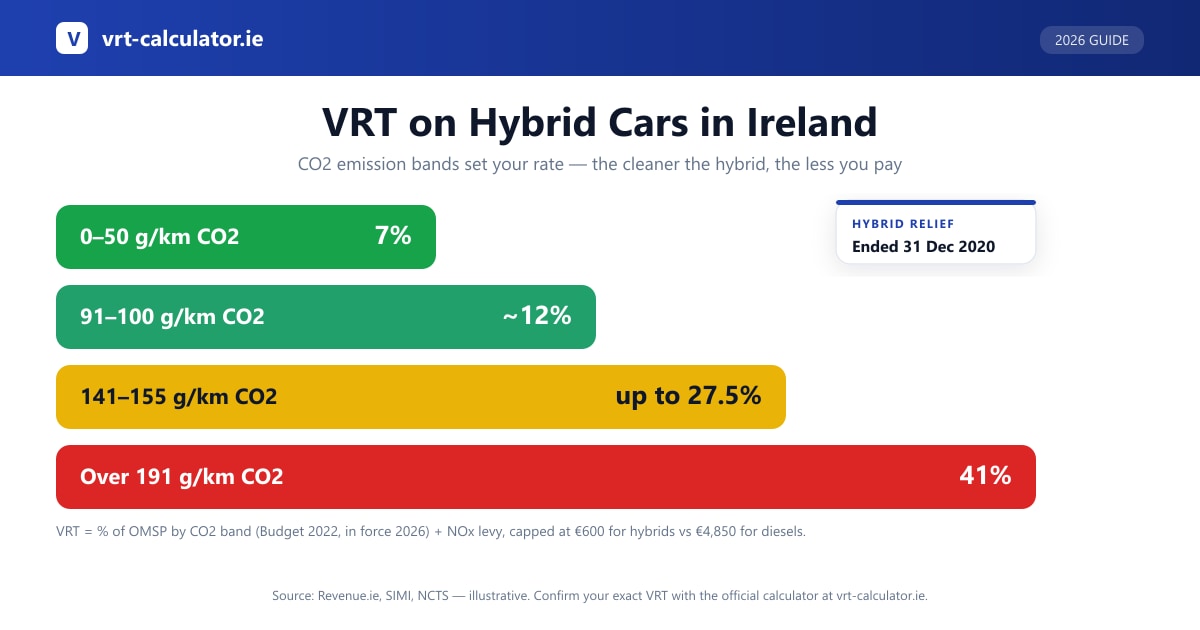
How VRT on a hybrid is calculated
VRT on a hybrid equals the CO2 rate (7%–41% of the OMSP) plus the NOx levy, so the cleaner your hybrid, the less you pay. Now that we know hybrids are liable, the next question is how Revenue turns your car into a euro figure — and it comes down to three inputs.
Step 1 – The OMSP (Open Market Selling Price)
The OMSP is Revenue's own estimate of what your car would sell for on the Irish market, and it includes VAT. You cannot choose it: Revenue sets the value based on the make, model, age, mileage and condition. When you import a car, VRT is charged on this Irish OMSP, not on the price you actually paid abroad.
Step 2 – Your CO2 band and rate
Your WLTP CO2 figure (in grams per kilometre) decides which percentage band applies, and hybrids usually sit in the lower bands. The Budget 2022 table still applies in 2026:
| CO2 (g/km, WLTP) | VRT rate | Minimum charge |
|---|---|---|
| 0 – 50 | 7% of OMSP | €140 |
| 51 – 80 | 9% | €180 |
| 81 – 90 | 9.75% – 10.5% | €195 – €210 |
| 91 – 100 | 11.25% – 12% | €225 – €240 |
| 101 – 120 | 12.75% – 16% | €255 – €320 |
| 121 – 140 | 16.75% – 20% | €335 – €400 |
| 141 – 155 | 21.5% – 27.5% | €430 – €550 |
| 156 – 190 | 30% – 35% | €600 – €700 |
| Over 191 | 41% | €820 |
Step 3 – The NOx levy
Hybrids pay the NOx levy like petrol cars, but it is capped at €600 — far below the €4,850 diesel cap (SIMI/Revenue). The levy applies to vehicles registered after 31 December 2019:
- €5 per mg/km for the first 0–40 mg/km
- €15 per mg/km for 41–80 mg/km
- €25 per mg/km above 80 mg/km
A worked example: VRT on a typical imported hybrid
For a used Toyota Corolla 1.8 Hybrid with an OMSP of €25,000 and CO2 of 95 g/km, the VRT would be the 11.25% band rate plus a small NOx levy. The formula is easier to trust once you see it applied to a named model.
Applying the same formula to other popular hybrids shows how the model — its OMSP and CO2 — drives the bill. A plug-in like the Kia Niro can carry a higher OMSP yet a lower VRT than a conventional hybrid, because its very low CO2 lands it in the 7% band:
| Hybrid model | Type | Illustrative OMSP | CO2 (WLTP) | VRT rate | ≈ Total VRT |
|---|---|---|---|---|---|
| Toyota Corolla 1.8 Hybrid | HEV | €25,000 | 95 g/km | 11.25% | ≈ €2,960 |
| Toyota C-HR 1.8 Hybrid | HEV | €34,000 | 110 g/km | ~14% | ≈ €4,810 |
| Kia Niro PHEV | PHEV | €38,000 | 20 g/km | 7% | ≈ €2,700 |
Illustrative figures based on the 2026 CO2 bands (CO2 charge + a small NOx levy). Your exact OMSP and rate come from Revenue's official calculator.
Why hybrids are still cheaper to register (even without relief)
Even though the dedicated hybrid VRT relief ended in 2020, hybrids still cost less to register than equivalent petrol or diesel cars because of lower CO2 and a capped NOx charge. If the special relief is gone, you might wonder why anyone says hybrids are tax-friendly — here is the real reason:
- Lower CO2 means a lower band. Most hybrids and PHEVs sit in the 7%–16% bands, not the punishing 35%–41% bands.
- PHEVs go lower still, thanks to very low official WLTP CO2 figures.
- The NOx levy is capped at €600 for hybrids, a fraction of the €4,850 diesel cap.
What happened to the old hybrid VRT relief?
The hybrid VRT relief of up to €1,500 (and up to €2,500 for plug-in hybrids) applied only to cars registered before 31 December 2020 and no longer exists. Because so many buyers still expect that discount, it is worth being precise about exactly when it ended.
- It covered Category A or B HEVs (max €1,500) and PHEVs (max €2,500), tapering with vehicle age (vrt.ie, 2020).
- It is not available for cars first registered now.
- A VRT export repayment estimate can still reflect a prior hybrid relief, so the figure is recalculated at the NCTS centre on examination (ROS).
How to get your exact hybrid VRT and register the car
Get your exact hybrid VRT by entering the make, model and version into the official VRT calculator, then register at an NCTS centre within 30 days of the car arriving. With the theory covered, the practical step is turning an estimate into the figure you actually pay.
- Estimate first using the VRT calculator to confirm the OMSP and band.
- Book your NCTS appointment within 7 days of the car entering the State (NCTS).
- Register and pay within 30 days — the NCTS collects the VRT for Revenue.
Frequently asked questions about VRT on hybrids
A few specific cases come up often enough to answer directly.
What vehicles are exempt from VRT?
Very few — and hybrids are not among them. Exemptions are narrow, covering things like a genuine transfer of residence and vehicles under the Disabled Drivers and Disabled Passengers Scheme. A standard hybrid or PHEV always pays VRT.
Is VRT cheaper on electric cars than hybrids?
Yes. Electric cars can still claim VRT relief of up to €5,000 in 2026, while hybrids get no relief at all — only the advantage of lower CO2 bands and the capped NOx levy.
Do older hybrids registered before 31 December 2020 still get relief?
The relief applied at original registration before the end of 2020. If a car already received it, that is settled history; it cannot be claimed on a hybrid first registered in Ireland now.
When do I have to pay the VRT on an imported hybrid?
At registration, which must take place within 30 days of the car entering the State, at an NCTS centre. Booking the appointment within 7 days of arrival keeps you inside the deadline.
Published 15 June 2026 by the VRT Calculator Ireland team — VRT and vehicle-import specialists. Verified against Revenue.ie published rules.