VRT on a BMW is charged on Revenue's valuation of the car, not on the price you paid, at a rate between 7% and 41% set by its CO2 emissions. That single rule explains why two BMWs bought for the same money can land with very different tax bills: a plug-in 330e might cost a couple of thousand euro to register, while a six-cylinder X5 diesel can cost more than a small hatchback. Diesels also pick up a NOx levy, and a car coming from Great Britain carries customs duty and VAT before VRT is even calculated. BMW is no niche marque here either: BMW Group Ireland registered 5,868 vehicles in 2025 (BMW Group Ireland press release, 2026), so plenty of buyers face this sum every year. The easiest first step is to run your BMW through our VRT calculator, then use this guide to understand the figure it gives you.
How Revenue calculates VRT on a BMW
Every BMW passenger car is taxed in VRT Category A, where the charge equals the OMSP multiplied by the rate of its CO2 band, plus the NOx levy. There is no BMW-specific rate: a BMW pays exactly what any car with the same value and emissions pays. Before VRT is worked out, the car is classified as an M1 passenger vehicle and given a statistical code (Revenue, VRT Manual Part 1A, updated 8 September 2026), under rules set by Part II, Chapter IV of the Finance Act 1992.
OMSP: Revenue's value, not your invoice
The OMSP (Open Market Selling Price) is the price Revenue believes the car would sell for in Ireland, taxes included. It reflects:
- the exact model, engine and trim level;
- age and mileage, through depreciation;
- optional extras such as M Sport packs, which can push the value up.
If a BMW version is missing from Revenue's database, the value is set after inspection using Irish and UK trade guides and advertisements (Revenue, Assessing the value, updated 9 October 2026). Expect the confirmed figure to differ from any online estimate.
CO2 bands from 7% to 41%
The rate comes from the WLTP CO2 figure on the car's paperwork. The bands that matter most for BMWs are below (Revenue rates applying since 2022).
| Band | WLTP CO2 (g/km) | VRT rate |
|---|---|---|
| 1 | 0 to 50 | 7% (minimum €140) |
| 6 | 96 to 100 | 12% |
| 13 | 131 to 135 | 17.25% |
| 17 | 151 to 155 | 21% |
| 18 | 156 to 170 | 25% |
| 19 | 171 to 190 | 30% |
| 20 | over 190 | 41% (minimum €820) |
Small gaps make a big difference. A rear-wheel-drive 320d emits about 135 g/km, while the xDrive version is closer to 145 g/km, which moves it into a dearer band.
The NOx levy on top
The NOx levy is a second charge based on nitrogen-oxide emissions in mg/km. It is tiered at €5, €15 and €25 per mg/km and capped at €4,850 for diesels and €600 for other fuels (Revenue, 2026).
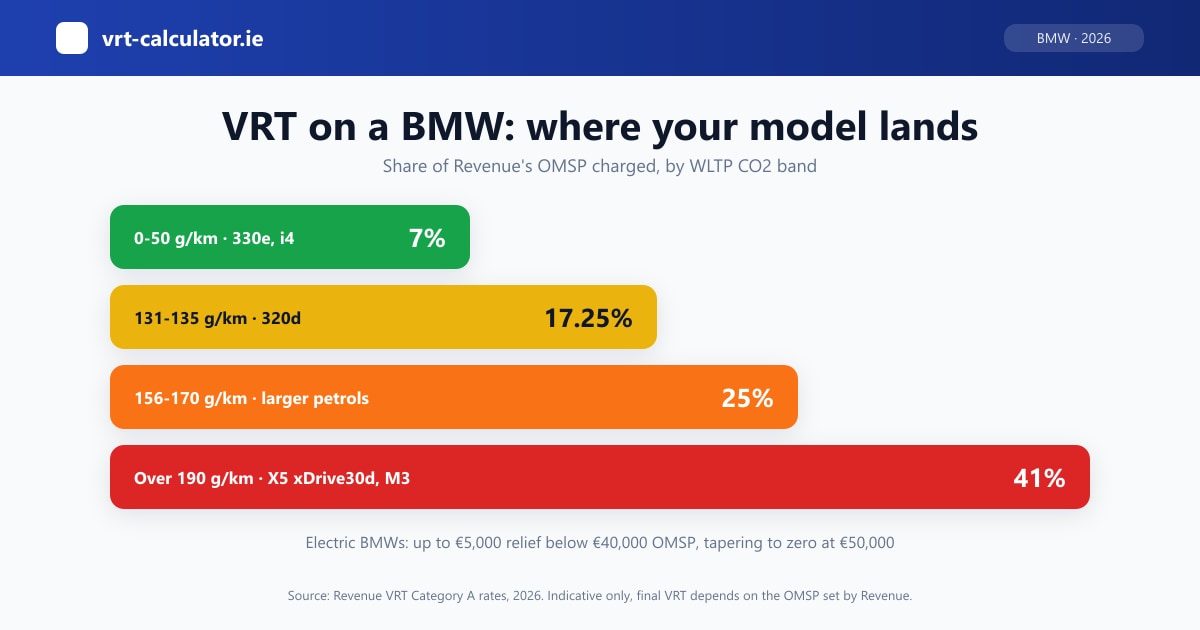
VRT by BMW model: indicative estimates for 2026
On a typical 2020 to 2022 BMW import, VRT runs from close to nothing on a sub-€40,000 i4 to well over €20,000 on an X5 diesel or an M3. With the formula in place, the quickest way to see what it means is to run it across the BMW range. The table below uses assumed OMSP values and typical emissions, so treat every line as an illustration rather than a quote.
| Model | Fuel | WLTP CO2 | Rate | Assumed OMSP | Indicative VRT incl. NOx |
|---|---|---|---|---|---|
| 320d (2020) | Diesel | 131 to 135 g/km | 17.25% | €28,000 | €5,005 |
| 330e (2021) | Plug-in hybrid | under 50 g/km | 7% | €32,000 | €2,290 |
| 520d (2020) | Diesel | 136 to 140 g/km | 18% | €30,000 | €5,600 |
| X5 xDrive30d (2020) | Diesel | over 190 g/km | 41% | €55,000 | €22,700 |
| i4 eDrive40 (2022) | Electric | 0 g/km | 7% less relief | €38,000 | €0 |
| iX xDrive40 (2022) | Electric | 0 g/km | 7%, no relief | €60,000 | €4,200 |
| M3 Competition (2021) | Petrol | over 190 g/km | 41% | €75,000 | €30,875 |
Diesel and petrol BMWs
The BMW 320d VRT bill is a useful benchmark: four-cylinder diesels such as the 320d and 520d sit in the 17% to 18% bands, which keeps VRT around the €5,000 mark on a mid-value car. The picture changes once you add cylinders or weight:
- BMW X5 VRT jumps because the X5 xDrive30d crosses 190 g/km, so 41% applies to a high OMSP;
- the M3 Competition pays the same 41% on an even higher value;
- xDrive versions of the 3 and 5 Series often sit one or two bands above their rear-wheel-drive twins.
On an M car or a big SUV, VRT alone can reach 40% of what the car is worth in Ireland, which is why so many M3 import plans stop at the calculator stage.
Plug-in hybrid and electric BMWs
BMW 330e VRT shows how a plug-in hybrid escapes the steep bands: the 330e has an official CO2 figure is low enough for the 7% rate, even though hybrid relief itself ended in 2022. Fully electric BMWs do better still:
- BMW i4 VRT can fall to nil, because an i4 with an OMSP under €40,000 qualifies for EV relief of up to €5,000, which wipes out the 7% charge in our example;
- above €40,000 the relief tapers, and it disappears entirely at €50,000;
- an iX valued at €60,000 therefore pays the full 7%.
Buyers are following the numbers: more than 19% of BMW Group Ireland registrations in 2025 were fully electric (BMW Group Ireland, 2026).
Diesel BMWs and the NOx levy
On a diesel BMW the NOx levy is added after the CO2 charge and is capped at €4,850, so the emissions figure on the Certificate of Conformity matters as much as the CO2 one. The table shows diesels in the middle of the pack, but their bill has a second layer that petrol and electric BMWs barely feel. The levy is cumulative across three tiers:
- €5 per mg/km for the first 40 mg/km;
- €15 per mg/km between 40 and 80 mg/km;
- €25 per mg/km above 80 mg/km.
A Euro 6 320d emitting 35 mg/km pays 35 × €5, or €175, which is why it barely moves the total in our table. An older diesel at 120 mg/km is a different story: €200 for the first tier, €600 for the second and €1,000 for the third, so €1,800 on top of the CO2 charge. If no valid NOx figure can be shown, Revenue applies the maximum charge, so get the CoC from the seller before you pay. Our NOx calculator guide walks through the tiers with more examples.
Importing a BMW: Great Britain vs Northern Ireland
Where the BMW comes from changes the total far more than the model does: a used BMW from Great Britain usually pays 10% customs duty and 23% VAT before VRT, while one from Northern Ireland normally pays VRT only. VRT and NOx are only part of the import bill once the car crosses a customs border. Because BMWs are built outside the UK (in Germany, the US, South Africa and elsewhere), they do not qualify as UK-origin goods under the trade agreement, so duty applies when they come from Great Britain.
Worked example: a 2020 BMW 320d
Take a 2020 320d bought for £20,000, converted at an assumed rate of 1.17 (€23,400), with an OMSP of €28,000. Shipping is left out for simplicity, although it also forms part of the customs value.
| Cost line | From Great Britain | From Northern Ireland |
|---|---|---|
| Purchase price | €23,400 | €23,400 |
| Customs duty (10%) | €2,340 | €0 |
| Import VAT (23% on price plus duty) | €5,920 | €0 |
| VRT and NOx levy | €5,005 | €5,005 |
| Total before shipping | €36,665 | €28,405 |
The same car costs €8,260 more when it comes from Great Britain. That gap explains why many Irish buyers now search dealers in Belfast, Newry and Derry first. The rules for that route are covered in our guide to VRT from Northern Ireland.
Is importing still worth it?
For any BMW import into Ireland, the test is simple: compare your total landed cost with the asking price of an equivalent BMW already registered in Ireland. Check three things before you commit:
- the Irish price of the same year, mileage and specification on DoneDeal or Carzone;
- your total from the table above, plus transport and a few hundred euro in contingency;
- whether the OMSP Revenue confirms could come in higher than your estimate.
A GB import now only makes sense when the UK price is well below the Irish one, typically on high-spec cars where the discount covers duty and VAT.
Registering your BMW: deadlines and paperwork
An imported BMW must be booked in with the NCTS within 7 days of arriving in Ireland and registered, with VRT paid, within 30 days (Revenue, Vehicle Registration Tax, updated 3 October 2026). Once the numbers make sense, the next risk is the calendar, because the registration clock starts the day the car lands. The sequence is:
- Book a VRT appointment with the NCTS online.
- Gather the V5C logbook, purchase invoice, Certificate of Conformity, photo ID and proof of Irish address.
- Present the car for inspection, where the details and the OMSP are confirmed.
- Pay the VRT, then collect your Irish registration number.
- Fit Irish plates and arrange motor tax and insurance.
A new BMW needs an electronic CoC recorded on Revenue's system before it can be registered (Revenue, VRT Manual Part 1A, 2026). Missing the 30-day limit can bring penalties, so book early even if the paperwork is still on its way.
Four ways to lower the VRT on a BMW
The cheapest BMW to register is the one with the lowest CO2 figure and the lowest Irish market value, so the choice of engine and drivetrain matters more than haggling on price. Knowing the process, you can work backwards and choose a BMW that keeps the bill down:
- Go electric below €40,000 of OMSP: an i4 or iX1 in that range can register for very little. Our guide to VRT on electric cars explains the relief taper in detail.
- Pick a plug-in hybrid: BMW Group Ireland registered 3,153 plug-in hybrids in 2025, up 33% (BMW Group Ireland, 2026), and most sit in the 7% band.
- Choose rear-wheel drive: skipping xDrive often saves one or two bands.
- Watch the extras: big option packs raise the OMSP, and VRT is charged on that value.
Always confirm the exact CO2 and NOx figures of the version you are buying, since two cars with the same badge can sit in different bands.
Frequently asked questions about VRT on a BMW
Can I check the VRT on a BMW for free?
Yes. Revenue's VRT calculator on ROS is free, and ours works as a BMW VRT calculator for every model at no cost. Both give estimates only. Revenue's tool does not cover models that have never been valued before or that need special research, such as some prestige versions, so a rare M model may need an inspection to get a figure.
What if the BMW is less than 6 months old or under 6,000 km?
It counts as a "new means of transport". You then pay 23% VAT in Ireland on top of VRT, even if the car was bought in another EU country and VAT was paid there. The seller can usually zero-rate the sale abroad.
Can I challenge Revenue's valuation of my BMW?
Yes. Ask Revenue for a review and back it up with evidence, such as Irish adverts for the same model, year, mileage and specification. If you still disagree, you can take the case to the Tax Appeals Commission.
Is VRT the same on a BMW from Japan or mainland Europe?
The VRT formula is identical whatever the origin. What changes is the rest of the bill: a used BMW from another EU country pays no customs duty, while one from Japan pays 10% duty and 23% VAT.
Can I bring my BMW to Ireland without paying VRT?
Yes, if you are moving here. Under transfer of residence relief, a car you owned and used abroad for at least 6 months before moving can be registered without VRT, provided you lived outside Ireland for at least 12 months.
Published 12 October 2026 by the VRT Calculator Ireland editorial team, VRT and vehicle-import specialists working from data published by the Revenue Commissioners. Checked against Revenue's published rules, updated October 2026.