Bringing a car from Northern Ireland to Ireland in 2026 usually means no customs duty and no import VAT — but VRT and the NOx levy still apply, and knowing the difference is what protects your budget. For a used car acquired in Northern Ireland (NI), Revenue treats the vehicle very differently from one shipped in directly from Great Britain: provided the car genuinely qualifies under Northern Ireland's post-Brexit status, the two heaviest import charges simply do not arise.
That single distinction is where thousands of euro are won or lost. A qualifying NI car skips the 10% customs duty and 23% import VAT that a Great Britain purchase attracts, while still paying exactly the same VRT it would pay wherever it came from. The catch is that the exemption depends entirely on the car's history and your paperwork, not on the fact that you crossed the border. This guide explains which taxes apply, when VAT and customs duty fall away, what evidence you need, and how to estimate the total before you commit.
Do you pay import duty or VAT on a car from Northern Ireland?
In most cases you pay no customs duty and no import VAT on a used car brought from Northern Ireland to Ireland — provided the vehicle genuinely qualifies under Northern Ireland's post-Brexit status. This is the single biggest reason Irish buyers look north rather than to Great Britain, where those two charges can add a third or more to the landed cost.
Revenue's position is precise: used cars bought in Northern Ireland can be imported without customs duty and import VAT only if the vehicle was legally imported into NI and meets the Windsor Framework requirements (Revenue, 2026). Where those conditions are not satisfied, customs duty and import VAT may arise in addition to VRT. So the exemption is real, common, and well established — but it is conditional, not automatic.
When a Northern Ireland car is free of customs duty and VAT
A Northern Ireland car escapes customs duty and VAT when it is genuinely in free circulation in NI and you can show that with documents. In practice, "qualifying" comes down to the vehicle's status before you ever get involved. A car typically qualifies when:
- It was in Northern Ireland before 1 January 2021, giving it EU-registered status.
- It was properly brought into NI under the Windsor Framework after that date and is in free circulation there.
- Its paperwork — logbook, service and test history — supports a genuine NI presence rather than a quick pass-through.
When those boxes are ticked, Revenue applies VRT only, and the customs and VAT lines on your bill read zero.
When VAT or customs duty can still apply
VAT and customs duty come back into play the moment the car cannot be shown to belong to Northern Ireland. The most common trap is a vehicle that was really a Great Britain car routed through the North purely to dodge charges, with nothing to prove NI use. Two situations in particular pull a car back into the taxable net:
- No evidence of NI history. If you cannot prove the car was in free circulation in NI, Revenue may treat it as a Great Britain import and charge duty and VAT.
- A new or nearly-new vehicle. A car that counts as a new means of transport for VAT purposes is treated differently and can attract VAT regardless of the route.
In those cases the customs and VAT charges land on top of VRT, which is exactly the outcome the NI route is meant to avoid.
VRT is always payable: how it is calculated
VRT is always payable when a Northern Ireland car is first registered in Ireland, and it is charged on the vehicle's Open Market Selling Price (OMSP) — Revenue's view of the car's Irish market value — not the price you actually paid. This is the one charge you cannot design your way out of, so it deserves close attention.
VRT raised, together with motor tax, €1.9 billion in 2024 (Comptroller and Auditor General report, via RTÉ, 2025), which tells you how seriously Revenue treats the calculation. The final figure is only confirmed once the car is inspected at your VRT appointment, but you can get very close beforehand if you understand the two inputs that drive it: the OMSP and the emissions profile.
How VRT is worked out: OMSP, CO₂ and the calculator
VRT on a passenger car (Category A) is 7% to 41% of the OMSP depending on the CO₂ band, with a minimum of €140 to €820 (Revenue, 2026). The lower your emissions, the lower the rate — which is why two cars with the same price tag can carry very different VRT bills. Revenue's published band anchors include, for example, 0–50 g/km at 7% (minimum €140), 151–155 g/km at 27.5% (minimum €550), and more than 190 g/km at 41% (minimum €820). Commercial Category C vehicles are charged a flat €200. The table below shows how the same rules land on three very different cars.
| Vehicle profile | Example OMSP | CO₂ (g/km) | VRT | NOx levy |
|---|---|---|---|---|
| EV hatchback | €38,000 | 0 | €0 after relief* | €0 |
| Petrol saloon | €16,000 | mid band | band-set (7%–41%) | negligible |
| Diesel estate | €18,000 | 152 | €4,950 (27.5%) | several hundred € |
*The EV VRT relief of up to €5,000 (Budget 2026) wipes out the modest VRT on a sub-€40,000 electric car. The petrol row deliberately shows no fixed figure: its rate is set by the exact CO₂ band, so this is precisely the case where a calculator earns its keep.
The NOx levy: cheap on petrol, costly on old diesel, zero on EVs
On top of VRT, Category A cars carry a separate NOx levy based on the car's nitrogen-oxide emissions. It is easy to forget and occasionally the sting in the tail of a diesel bargain. The pattern is consistent:
- Petrol and hybrid cars: the NOx charge is usually negligible.
- Older, high-NOx diesels: the levy can run to several hundred euro and, on the worst offenders, well beyond.
- Electric vehicles: the NOx levy is €0.
- Commercial vehicles: the NOx levy does not apply.
Because the levy tracks emissions rather than value, a cheap old diesel can carry a surprisingly large NOx bill — another reason to model the full charge before you buy.
The two ways a Northern Ireland car avoids VAT and customs duty
There are two channels that make a Northern Ireland car free of VAT and customs duty: either it was in Northern Ireland before 1 January 2021, or it was brought into Northern Ireland under the Windsor Framework and is in free circulation there. Having seen that VRT is fixed whatever you do, the savings clearly live in the customs and VAT lines — and whether you keep those savings depends on which channel applies.
Channel 1: cars in Northern Ireland before 1 January 2021
A car that was registered or in use in Northern Ireland before 1 January 2021 is treated as an EU-registered vehicle, so no VAT or customs duty applies when you import it to the Republic — regardless of the car's age (Revenue; CompleteCar, 2025). The critical point is proof of when the car arrived in the North. A vehicle that landed in NI before that midnight cut-off carries its EU status with it, but the burden is on you to show the timeline. A car first registered in England in 2019 and traded into a Northern dealer in late 2020, for instance, qualifies — provided the paperwork tells that story cleanly.
Channel 2: cars brought into NI under the Windsor Framework
The second channel covers cars that entered Northern Ireland after the cut-off. Under the Windsor Framework, a vehicle properly brought into NI and in free circulation there can still be imported into the Republic without VAT or customs duty (Revenue, 2026). What matters here is that the car was genuinely imported into Northern Ireland under the correct rules and declared appropriately — not simply driven across on its way south. If the vehicle is in free circulation in NI and you can evidence it, the exemption holds. If its NI presence is only nominal, Revenue can look through the arrangement and treat it as a Great Britain import.
The proof you need to keep VAT and customs duty at zero
The single thing that protects you from a VAT and customs bill is documentary proof that the car genuinely belongs in Northern Ireland — Revenue's decision rests on paperwork, not on where you happened to buy it. Both exemption channels share this requirement, and it is where most disputed cases are settled.
Revenue looks for evidence that the car lived and worked in Northern Ireland, not that it merely passed through. Irish motoring commentators consistently make the same point: the strongest single proof is a Northern Ireland registration history, and a used car should have been properly in NI for a reasonable period — around three months is commonly treated as enough for VAT purposes — provided you can demonstrate it. Gather and keep the following before you buy:
- The original V5C registration certificate showing the last keeper was resident in Northern Ireland.
- A Northern Ireland service history for the vehicle.
- The NI MOT test history, where the car is old enough to require one.
- Insurance details in the last NI keeper's name and address, covering the registration and period of cover.
- Where requested, telematics data — including EV charging-station locations — showing a usage pattern consistent with NI ownership (Revenue, 2026).
Northern Ireland vs Great Britain: a worked cost comparison
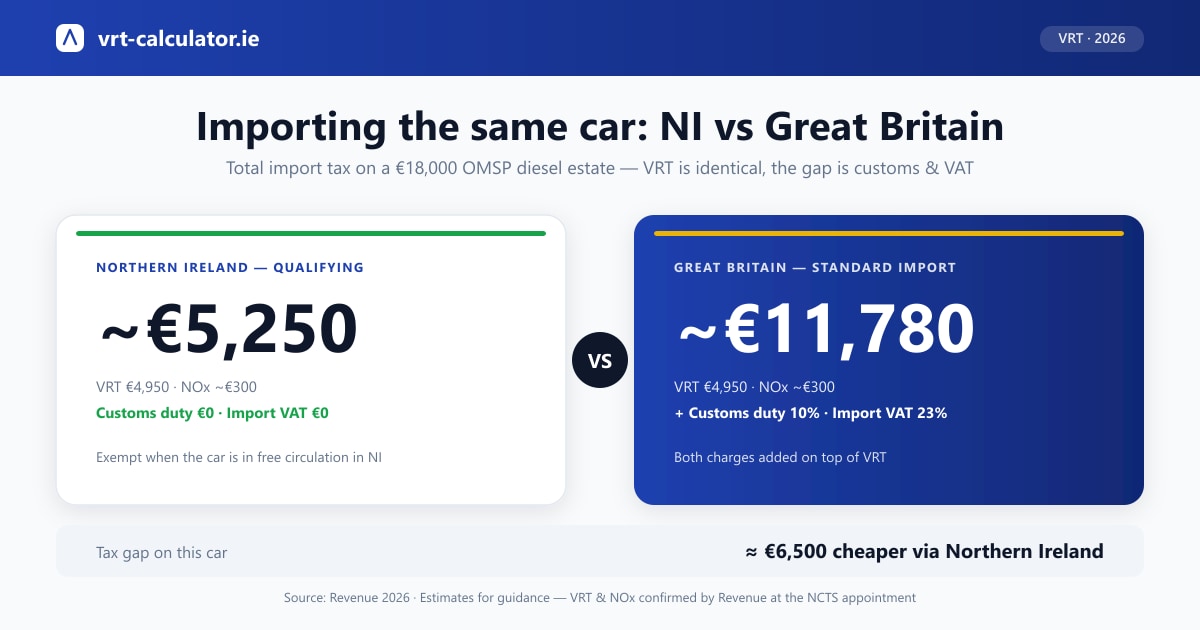
A qualifying Northern Ireland car can be thousands of euro cheaper to import than the same car from Great Britain, because the Great Britain route adds 10% customs duty and 23% import VAT on top of VRT — charges the NI route usually avoids entirely. VRT itself is identical either way, since it is based on the OMSP and emissions, not on where the car came from. With the rules and the proof in hand, the value of the Northern Ireland route becomes obvious the moment you line the numbers up. The comparison below uses the same diesel estate for both routes.
| Cost line | Northern Ireland (qualifying) | Great Britain |
|---|---|---|
| Purchase price (indicative) | ~€18,500 | ~€18,500 |
| Customs duty (10%) | €0 | ~€1,850 |
| Import VAT (23%) | €0 | ~€4,680 |
| VRT (27.5% of €18,000 OMSP) | €4,950 | €4,950 |
| NOx levy | ~€300 | ~€300 |
| Total tax on import | ~€5,250 | ~€11,780 |
The purchase price also tends to differ: similar models can be €2,000–€5,000 apart before any tax is counted (comparison sources, 2026). The tax gap alone, though, is roughly €6,500 on this car.
Worked example: a diesel estate bought in Northern Ireland
Take a diesel estate with an OMSP of €18,000 and CO₂ of 152 g/km, landing it in the 27.5% band. The VRT works out at €4,950 (27.5% × €18,000), the NOx levy at a few hundred euro for a typical older diesel, and — because the car qualifies under the NI rules — customs duty and VAT are both zero. The total tax to get that car on Irish plates is therefore around €5,250, on top of the purchase price. Nothing here depends on how good a deal you struck at the forecourt; VRT and NOx are driven purely by the OMSP and the emissions profile.
The same car from Great Britain, side by side
Buy the identical estate imported from Great Britain and the picture changes sharply. On an indicative customs value of €18,500 you would add roughly €1,850 in customs duty (10%), then 23% import VAT on the value-plus-duty — about €4,680. VRT (€4,950) and NOx (~€300) are unchanged. The Great Britain total tax climbs to around €11,780 — more than double the Northern Ireland figure. That €6,500 swing is the whole reason the NI route exists, and it is why proving the car's Northern Ireland status is worth the paperwork effort.
Step by step: from choosing the car to paying VRT
Importing a Northern Ireland car follows a fixed sequence: confirm it qualifies, gather your proof, cross the border, book the NCTS inspection within 7 days, then register and pay VRT within 30 days of the car entering the State. Miss those deadlines and you risk late-registration charges on top of everything else. Once the numbers stack up, the process itself is straightforward as long as you keep to Revenue's timelines:
- Confirm the car qualifies — check which exemption channel applies and that the history supports it.
- Assemble the proof — V5C, NI service and MOT history, insurance details.
- Estimate the cost — run the VRT and NOx figures so there are no surprises.
- Complete the purchase and bring the car into the State.
- Book your NCTS inspection within 7 days of the car entering Ireland.
- Attend the appointment, present the documents, and let Revenue confirm the VRT.
- Pay the VRT and register within 30 days of entry.
Qualifying NI cars generally need no customs declaration. A car that fails to qualify does need one — along with a Movement Reference Number (MRN) and an EORI number — which is another reason to settle the car's status before you drive south.
Estimate your VRT and NOx before you buy
The safest way to avoid a nasty surprise is to estimate VRT and NOx before you commit — feed the make, model, year, fuel type and CO₂ figure into our VRT calculator and you get a realistic total in seconds. Because VRT is the one charge you cannot escape, pinning down its size before you hand over any money is the smartest move a buyer can make. Have these details ready so the estimate is as accurate as possible:
- The OMSP the car is likely to attract (Revenue's valuation, not your price).
- The CO₂ band, which sets the VRT rate between 7% and 41%.
- The NOx value, which drives the separate levy.
- The fuel type and the date of first registration.
Remember that any estimate is exactly that: the amount Revenue confirms at your VRT appointment is the figure that counts. But a good estimate turns a nerve-wracking purchase into a calculated one — and tells you instantly whether that Northern Ireland bargain is still a bargain once tax is in the frame.
Frequently asked questions
A few practical questions come up again and again once the main rules are clear. These edge cases are the ones that most often trip up first-time importers, and none of them are covered above.
Can I drive the car on its Northern Ireland plates before I register it here?
Only briefly. You must register the car within 30 days of it entering the State, and drive it to your NCTS appointment in that window. Driving an unregistered import beyond the deadline exposes you to penalties, so book the inspection promptly once the car is in Ireland.
What happens if I can't prove the car was used in Northern Ireland?
Without proof, Revenue may treat the vehicle as a Great Britain import and charge customs duty and VAT on top of VRT. That can add thousands to the bill, which is why the V5C, service history and MOT record matter far more than the receipt from the seller.
Is the NOx levy charged on vans and commercial vehicles from Northern Ireland?
No. The NOx levy does not apply to commercial vehicles, and Category C commercials pay a flat €200 VRT rather than a percentage of OMSP. That makes the tax position on a qualifying Northern Ireland van considerably simpler than on a passenger car.
Do I need an EORI number to bring a car from Northern Ireland?
Only if a customs declaration is required — which, for a qualifying NI car, it usually is not. If the vehicle fails to qualify and must be declared, you will need an EORI number and a Movement Reference Number to complete the customs formalities.
Are electric cars from Northern Ireland cheaper to VRT?
Yes. Budget 2026 extended the EV VRT relief of up to €5,000 for another year, which wipes out the VRT on most sub-€40,000 electric cars, and the NOx levy on an EV is €0. A qualifying Northern Ireland electric car can therefore land with little or no VRT and no NOx at all.
Published 24 July 2026 by the VRT Calculator Ireland editorial team.