The VRT bus rule is simple: a bus with at least 10 seats including the driver's seat pays a flat VRT of €200 in Ireland, whatever its value or emissions (Revenue, Calculating VRT, 2026). The catch is the line just below it: a smaller minibus is taxed like a car, so the minibus VRT rate depends on its value and emissions. Before you buy a minibus or a coach abroad, check which side of that line it falls on, then run your figures through our VRT calculator. This guide covers the Irish Vehicle Registration Tax, not the foreign bus networks that share the acronym.
Which VRT category applies to a bus or minibus?
The number of seats, counted with the driver's seat, is what moves a passenger vehicle from Category A to Category C, and it settles the question of VRT on a bus before anything else. The category is confirmed at the NCT centre inspection, not by your foreign paperwork. If you also run vans or trucks, our guide to VRT on commercial vehicles explains how the same categories apply to goods vehicles.
| Vehicle | EU class | Seats (driver included) | VRT category | How VRT is charged |
|---|---|---|---|---|
| Minibus, people carrier | M1 | 9 or fewer | A | % of OMSP by CO2 band, plus NOx charge |
| Minibus, midi bus | M2 (up to 5 tonnes) | 10 or more | C | Flat €200 |
| Coach, large bus | M3 (over 5 tonnes) | 10 or more | C | Flat €200 |
| Ambulance, fire engine | Special purpose | Any | D | Nil |
Source: Revenue VRT Manual, Section 1A, and Revenue, Applying the tax, 2026.
The 10-seat threshold
Revenue counts permanently fitted seats, and the driver's seat is part of the count. A vehicle with nine seats in total is a Category A minibus. Add a tenth fixed seat and it becomes a Category C bus: that is the whole bus VRT Category C test. Folding or removable benches do not always count, which is why the NCT inspector checks how each seat is fixed to the floor.
Points that trip up buyers:
- Seats removed before shipping to cut weight can push a 12-seater back into Category A.
- Seats added after import do not lower VRT already paid.
Category D is not a school bus exemption
The same logic applies to VRT on coaches used by schools or tour firms. Category D applies only to special-purpose vehicles: ambulances, fire engines, refuse vehicles and vehicles used only to move road-construction machinery. A school bus, a community bus or a coach used for tours stays in Category C, even when it carries the public. Use alone does not move a passenger bus into Category D.
What you really pay when you import a bus
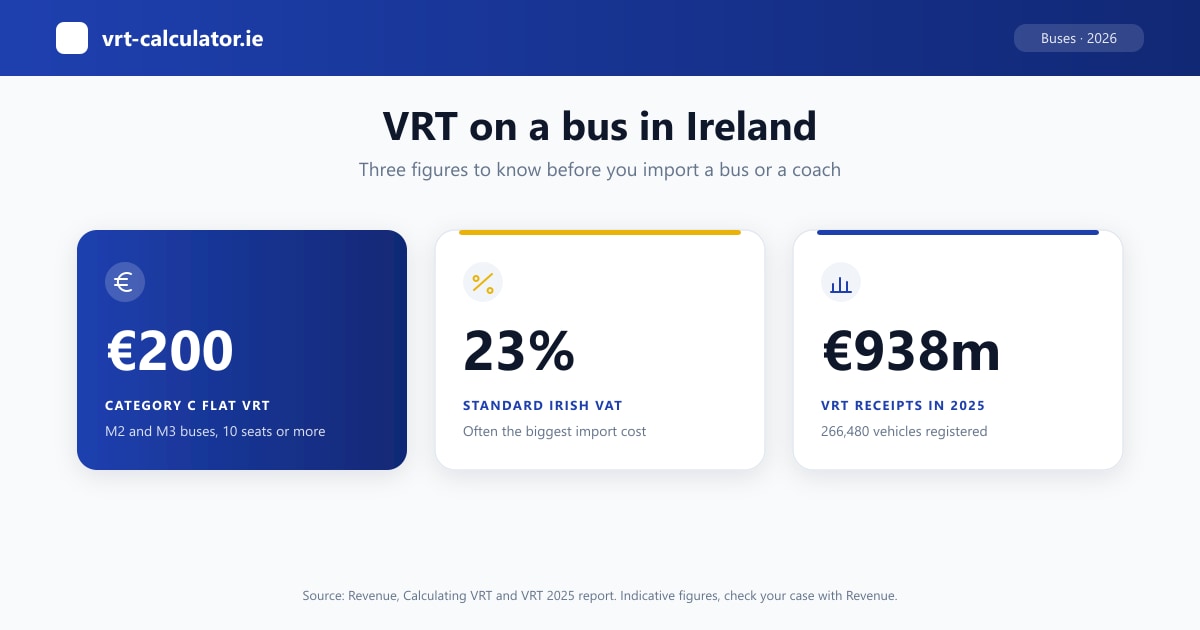
When you are importing a bus to Ireland, VRT is rarely the biggest cost: VAT at 23% and customs duty can weigh far more than the €200 flat rate. Once the category is known, the VRT itself is easy, but it is only one line of the bill.
VAT and customs duty from the UK
Since Great Britain left the EU, a bus bought in England, Scotland or Wales is a non-EU import. Revenue requires the VAT to be paid before the vehicle is released from customs control (Revenue, VAT and customs duty, 2026). Customs duty depends on the vehicle's tariff classification and origin:
- A bus that meets the rules of origin of the EU-UK Trade and Cooperation Agreement can enter with no customs duty, if you hold proof of UK origin.
- A bus built elsewhere and simply sold through a British dealer does not qualify, so duty applies at the tariff rate.
- A bus bought in Northern Ireland follows different rules for goods, so check its status with Revenue before paying anything.
Our guide to importing a vehicle from the UK walks through the customs declaration step by step.
Worked example: 8-seat minibus against 16-seat minibus
Take two minibuses with the same Open Market Selling Price (OMSP) of €30,000, both diesel, both in the 170 to 190 g/km CO2 band.
- 8 passengers plus driver (Category A): 35% of OMSP, so €10,500, plus a NOx charge of €5 per mg/km up to 40 mg/km, €15 per mg/km from 40 to 80 and €25 above, capped at €4,850 for diesel (Revenue VRT Manual, 2026).
- 16 seats (Category C): €200 flat, with no CO2 or NOx calculation.
The gap is more than €10,000 for two vehicles that may share the same body shell.
How to register an imported bus in Ireland
An imported bus must be registered within 30 days of arriving in the State, at a designated NCT centre and by appointment only (Revenue, VRT and registration, 2026). With the budget clear, the next step is the registration itself, and Revenue expects the booking to be made within 7 days of arrival.
- Book the inspection online; our page on booking your VRT appointment covers the NCTS booking system.
- Gather proof of identity and address, the foreign registration certificate, the purchase invoice and evidence of VAT and customs clearance.
- Present the bus at the appointment so the inspector can confirm the VIN, count the seats and record the category.
- Pay the VRT, then collect the Irish registration number and fit the number plates.
- Tax the vehicle at the motor tax office or online before using it on the road.
After registration: CVRT, licensing and camper conversions
A bus with more than eight passenger seats needs an annual CVRT test once it is over one year old, not an NCT (Department of Transport, gov.ie, 2026). Paying the VRT does not end the paperwork for a bus.
- CVRT: buses are tested as M2 (up to 5 tonnes) or M3 (over 5 tonnes) at an authorised CVRT test centre.
- Licensing: carrying passengers for payment requires an NTA licence (a PSV operator licence from the National Transport Authority) and the right driving licence category.
- Motor tax: the rate for a bus is set by its seating, so check the current figure on motortax.ie before budgeting.
Converting a bus into a motorhome
Turning a bus into a motor caravan does not remove the VRT or automatically change the category. Contact Revenue before the work starts. A converted motor caravan is tested under the CVRT system rather than the NCT (CVRT, 2026). Our guide to VRT on camper vans lists the equipment a conversion needs.
FAQ: VRT on buses and minibuses
How do I contact the NCTS about a VRT appointment?
Use the VRT section of ncts.ie, which publishes the current contact details for VRT inspections. Keep your booking confirmation as proof of the date you booked.
What is the statistical code of a bus?
The statistical code is a Revenue reference that identifies the make, model and version of a vehicle. For cars it links to the OMSP. For a Category C bus it matters less, because its flat rate does not depend on value.
Where do I find the registration certificate number after registering?
It is printed on the Irish vehicle registration certificate posted to the owner after the VRT is paid, and it is separate from the plate number.
Does an electric minibus get VRT relief?
Relief for electric vehicles is designed for Category A cars, which is the key point for any VRT minibus Ireland question: an electric minibus with nine seats or fewer can qualify under those rules, while an electric bus of 10 seats or more already pays the Category C flat rate.
Published 7 October 2026 by the VRT Calculator Ireland editorial team.