How much VRT is charged on a camper van in Ireland?
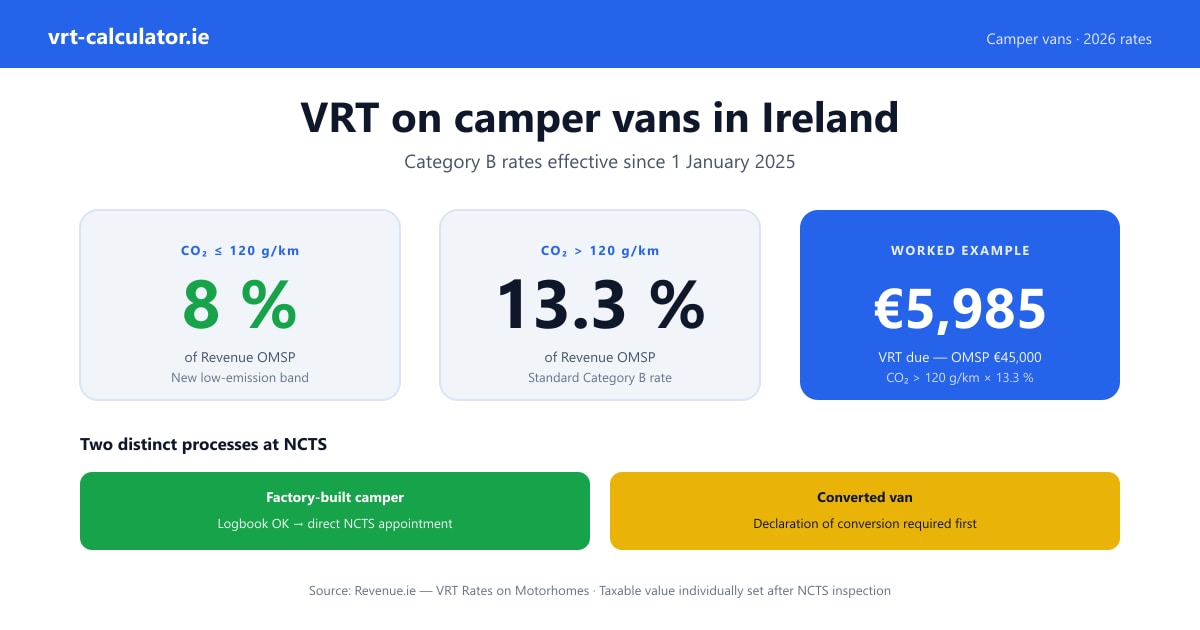
VRT Category B applies to motor caravans, with two rates since 1 January 2025: 13.3 % of OMSP if CO₂ emissions exceed 120 g/km, and 8 % at or below 120 g/km (Revenue). The lower 8 % band was introduced in Budget 2025 to incentivise lower-emission vehicles in Category B.
| CO₂ emissions | Rate | Applied to |
|---|---|---|
| 0 to 120 g/km | 8 % | OMSP set by Revenue |
| Above 120 g/km | 13.3 % | OMSP set by Revenue |
Both rates apply to the Open Market Selling Price (OMSP) that Revenue determines for your vehicle — not the price you paid the seller. This distinction matters: the bill at NCTS is almost always different from what a private invoice would suggest.
What qualifies as a "motor caravan" for VRT purposes?
Under EU/678/2011, a motor caravan is an EU Category M1, M2 or M3 vehicle with bodywork code SA, constructed to include living accommodation with at least the following equipment rigidly fixed to the living compartment:
- Seats and a table (the table may be designed to be easily removable).
- Sleeping accommodation (which may be converted from the seats).
- Cooking facilities.
- Storage facilities.
If any of these are missing — or if they are not rigidly fixed — Revenue will not classify the vehicle as a motor caravan, and a different VRT rate may apply. This is the framework that drives whether the 8 % / 13.3 % Category B rates apply at all.
Factory-built vs converted van: two distinct processes
An imported factory-built camper goes straight through NCTS with its logbook describing it as a motor caravan, while a van converted to camper must file a declaration of conversion before Revenue assigns a taxable value. The fork happens early and changes the timeline.
Factory-built camper: the NCTS appointment
Before you book the NCTS appointment, check the logbook (V5C or equivalent) to confirm the vehicle is described as a motor caravan. If the description is correct, the NCTS will:
- Perform a physical examination of the vehicle.
- Take or receive photos (interior and exterior) documenting make, model, version, conversion quality and overall condition.
- Transmit the file to Revenue, who then determines the taxable value and the VRT amount due.
You pay the VRT at the NCTS, receive your registration number, and once you tax the vehicle, the Vehicle Registration Certificate (VRC) is issued.
Converted van: the declaration of conversion
If you bought a van and converted it to camper, the logbook still describes it as a standard van. You must file a declaration of conversion before any taxable value can be set. Practical advice:
- Get the conversion professionally documented with photos at each stage.
- Ensure all required equipment is rigidly fixed (the EU 678/2011 wording is strict).
- Submit declaration via the standard Revenue route — Revenue may request additional photos.
How Revenue calculates the taxable value (OMSP) of a camper van
Because there are no trade guides for motor caravans, Revenue calculates the taxable value of each camper individually after NCTS inspection — using photos, the vehicle's age, condition and the quality of any conversion.
In practice, this means:
- Private listings on DoneDeal or similar are not a good proxy — they're typically below the dealer-equivalent value Revenue uses.
- The photos you submit influence the valuation — be thorough and honest, both interior and exterior.
- The Revenue ROS calculator explicitly excludes motor caravans from its scope, so you can't preview the bill before NCTS.
If you disagree with Revenue's assigned OMSP, you can lodge an appeal within 30 days of the assessment, backed by your own valuation research (comparable listings, dealer quotes, mileage and condition evidence).
FAQ — VRT on camper vans in Ireland
How much is VRT on a camper van?
VRT on a camper van is 13.3 % of OMSP for vehicles emitting more than 120 g/km CO₂, or 8 % at or below that threshold (Revenue, from 1 January 2025). On an OMSP of €45,000 above the 120 g/km band, that's around €5,985 in VRT.
Do you have to pay VRT on a caravan?
A towed caravan (no engine, towed by another vehicle) is not subject to VRT because it isn't registered as a self-propelled vehicle. Motor caravans / motorhomes with their own engine are subject to VRT as Category B vehicles.
Is there VRT on vans?
Yes. Standard light commercial vans fall in VRT Category B at the flat 13.3 % rate (or 8 % if low-CO₂). Heavy commercials sit in Category C at a flat €200. Vans converted to campers shift to motor caravan rules once the conversion is declared and validated.
What vehicles are exempt from VRT in Ireland?
The strictly exempt category is Category D, covering ambulances, fire engines and certain mobility-adapted vehicles. Motor caravans are NOT exempt — they qualify for the Category B rates above. Electric vehicles in Categories A and B get a separate relief (not an exemption).
Can I appeal Revenue's taxable value?
Yes. You can lodge an appeal within 30 days of the assessment, supported by valuation research (comparable dealer quotes, listings, mileage and condition documentation). Revenue accepts comparables as supporting evidence.
Published 23 May 2026 by the VRT Calculator Ireland editorial team.