You pay VRT directly to Revenue at an NCTS centre when your imported vehicle is registered, using a debit or credit card, bank draft, company cheque, or cash up to €250. There is no separate online payment for most private drivers: the tax is calculated and collected in person, at the moment of registration, by the National Car Testing Service acting on Revenue's behalf. If you have just brought a car into Ireland from Great Britain, Northern Ireland or further afield, the clock is already running — you must book your inspection quickly and settle the Vehicle Registration Tax within a strict deadline. This guide walks you through exactly where you pay, when, by which methods, how much to expect, and what happens if you leave it too late.
Where and when do you pay VRT in Ireland?
VRT is paid at a designated NCTS centre at the moment your vehicle is registered, and it must be done within 30 days of the vehicle entering Ireland. You do not pay it at a Revenue public office, a Garda station or a motor tax office — registration and payment happen together, in person, during your booked inspection appointment.
At the NCTS centre, on Revenue's behalf
The National Car Testing Service collects VRT on behalf of the Revenue Commissioners, who have delegated the job to Applus Inspection Services Ireland Ltd. Only around 22 of the current NCTS centres actually handle VRT, so it is worth confirming that your chosen location offers the service before you book. Once the inspection is complete and you have paid, a vehicle registration number is issued to you immediately, with no separate registration service charge applied at the centre. That is the reassuring part: you leave the appointment fully registered, ready to order your plates.
The 30-day payment deadline
Timing is the part drivers most often get wrong. You must book an inspection appointment within 7 days of the vehicle entering Ireland, and complete registration and payment within 30 days of that entry date (Revenue / NCTS, 2026). These two windows run in parallel from the day the car arrives in the State, not from the day you decide to register it. Failing to register within 30 days incurs additional VRT on top of the original bill, so the deadline is not one to test.
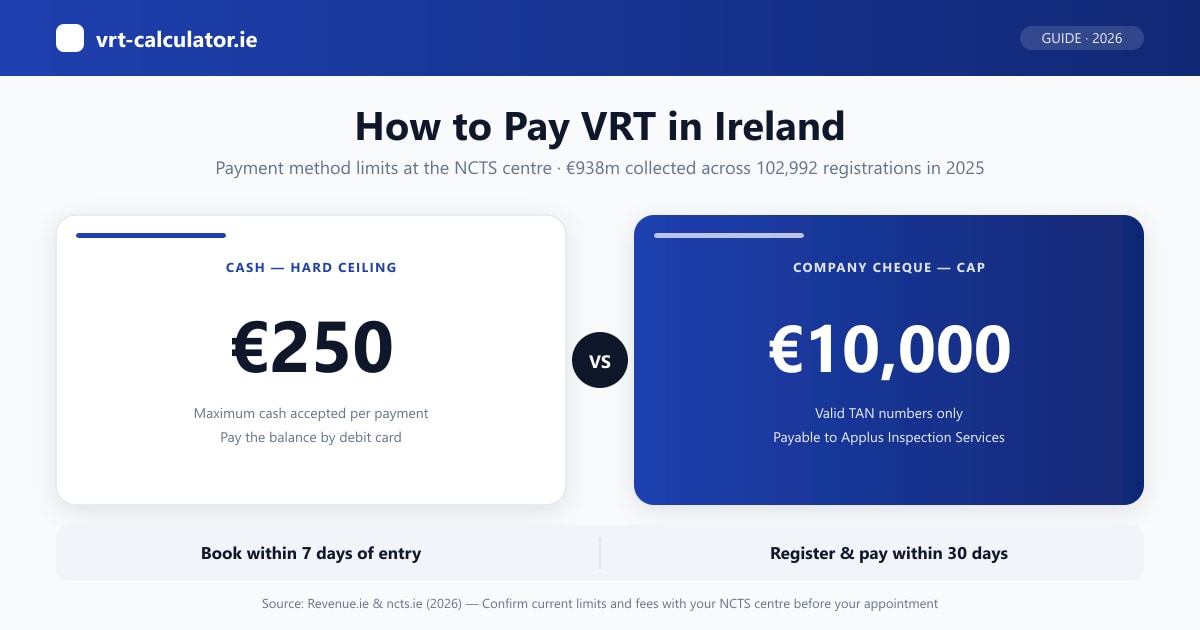
Accepted VRT payment methods at the NCTS centre
The NCTS centre accepts debit cards, credit cards (except American Express), bank drafts, postal orders, company cheques up to €10,000, and cash up to a €250 limit. In practice, most private drivers pay the bulk of the bill by card, because VRT amounts routinely run well beyond the cash ceiling. It pays to know the exact rules for each method before you turn up, so you are not caught short at the desk.
| Payment method | Accepted | Limit / condition |
|---|---|---|
| Debit card | Yes | No stated limit |
| Credit card | Yes (not American Express) | ~1.5% surcharge may apply |
| Bank draft / postal order | Yes | Payable to Applus Inspection Services Ireland Ltd |
| Company cheque | Yes | Up to €10,000, TAN numbers only, payable to Applus |
| Cash | Yes | Up to €250 only |
Limits, surcharges and who to make payment out to
Two details catch people out. First, cash is capped at €250 (ncts.ie/vrtfaq, 2026), so it can only ever cover a small slice of a typical VRT bill — bring a debit card for the balance. Second, paying by credit card can attract a surcharge of around 1.5%, and American Express is not accepted at all.
- Bank drafts and postal orders must be made payable to Applus Inspection Services Ireland Ltd, not to Revenue.
- Company cheques are accepted only with valid TAN numbers and only up to €10,000 (vrt.ie, 2026).
- A debit card has no stated ceiling, making it the simplest option for large amounts.
How to pay VRT step by step
To pay VRT, you book an NCTS appointment, bring your vehicle and documents, let the centre inspect and value it, then pay the calculated amount on the spot to receive your registration number. The process is deliberately linear, and knowing the order in advance removes most of the stress on the day.
1. Book your inspection appointment
Booking is the trigger for everything else. Reserve your slot within 7 days of the vehicle entering Ireland, online or by phone, at a centre that handles VRT. Because only a limited number of centres offer the service, popular locations can fill up — book as early as you can to stay inside the registration window.
2. Bring the required documents
The inspector cannot calculate or accept payment without the right paperwork, so gather it before you travel. You will typically need:
- The original purchase invoice or bill of sale for the vehicle.
- The foreign registration document (for example, the UK V5C).
- For UK imports, a completed customs declaration (C88/SAD) with proof of customs duty and VAT paid, plus proof of permanent export from the UK (borderpeople.info / NCTS, 2026).
3. Inspection, VRT calculation and payment
On the day, the centre examines the vehicle to confirm its identity and details, then Revenue's system calculates the exact VRT (including any NOx levy). You pay the assessed amount immediately using one of the accepted methods, and the registration number is issued on the spot. From there you can order and fit your Irish plates.
Paying VRT online through ROS or myAccount
Most private importers pay VRT in person at the NCTS centre, but traders and tax professionals can pay online through Revenue Online Service (ROS) or myAccount. This online route is not the standard path for a one-off private import — it mainly serves dealers, agents and specific cases such as vehicle conversions handled directly through Revenue's systems.
Where it applies, payment can be made by Single Debit Instruction (SDI) — a direct instruction to deduct the amount from a nominated current account — or by debit or credit card (Revenue TDM "VRT online payments in ROS and myAccount", 2026). If you are a private individual registering an imported car, you can safely assume the NCTS centre is your point of payment; the ROS and myAccount channels are there for professionals managing volume or non-standard registrations.
How much VRT will you pay? OMSP, CO₂ and NOx
The VRT you pay is a percentage of your vehicle's Open Market Selling Price (OMSP) set by its CO₂ emissions, plus a separate NOx levy for non-electric vehicles. In other words, two cars of identical value can attract very different bills depending on how much they emit. Knowing how the figure is built means the number at the desk is no surprise.
The CO₂ and NOx components
The CO₂ element applies a rate from a 20-band table, running from about 7% for the lowest emitters (0–50 g/km) up to roughly 41% for the highest (Revenue / SIMI, 2026). On top of that, the NOx charge adds up to €4,850 for diesel vehicles and up to €600 for others. A minimum VRT of €125 applies to Category B vehicles, so even the smallest bill has a floor.
Estimate the amount before your appointment
You do not have to wait for the inspection to know your likely bill. Enter your vehicle's details to get a VRT estimate with the VRT calculator before you go, so you can budget the right payment method and avoid arriving short. Revenue's own Vehicle Registration Online Enquiry System works from your car's CO₂ emissions and OMSP for the same purpose.
Extra charges to budget for: EMC levy and import VAT
On top of VRT, imported vehicles usually attract an EMC (NORA) tyre levy at registration, and vehicles brought in from outside the EU also face import VAT at 23%. These are separate from the VRT figure itself, and forgetting them is the most common budgeting mistake.
Since September 2022, every vehicle and motorcycle entering the Irish market for the first time must pay an EMC (tyre/NORA) levy at the point of registration (NCTS, 2026). And if the car comes from a non-EU country, import VAT of 23% applies before you even reach the VRT stage (Revenue, 2026), typically calculated on the purchase price plus transport and any customs duty. Factor both into your total so the final bill matches what you expected.
What happens if you pay VRT late?
If you miss the 30-day deadline, additional VRT is charged and the vehicle can ultimately be detained or forfeited — and VRT still cannot be spread across installments. Late registration is treated seriously precisely because payment and registration are a single legal step.
Practically, this means there is no payment plan and no grace period to rely on: the full amount is due at registration, within 30 days of the vehicle arriving in the State, and delays can escalate to penalties including vehicle forfeiture (Revenue / borderpeople.info, 2026). If you genuinely cannot make an appointment in time because no VRT-handling centre has availability, contact the NCTS as early as possible rather than letting the deadline pass in silence.
Frequently asked questions about paying VRT
Below are the most common practical questions drivers ask about paying VRT that aren't fully covered above. Each answer sticks to a point not developed in the main sections.
Can VRT be paid in installments?
No. VRT is due in full at the time of registration and cannot be split into installments or spread over time. You need the complete amount ready on the day of your NCTS appointment.
Do I pay VRT if I buy a new car from an Irish dealer?
Not separately. When you buy a new car from an Irish dealership, VRT is already included in the retail price and the dealer pays it to Revenue on your behalf (Revenue, 2026). You only handle VRT yourself when you personally import and register a vehicle.
Is there a surcharge for paying VRT by credit card?
Yes, a surcharge of around 1.5% can apply when you pay by credit card, and American Express is not accepted. A debit card avoids the surcharge, which is why most drivers use one for the balance.
How much cash can I use to pay VRT?
Cash is accepted only up to €250. Any amount above that must be paid by debit card, credit card, bank draft or company cheque, so cash alone rarely covers a full VRT bill.
Can I get my VRT back if I export the car?
In some cases, yes. A portion of the VRT may be repaid through the VRT Export Repayment Scheme when you permanently export a qualifying vehicle from the State, subject to Revenue's conditions and an examination before export.
Published 13 July 2026 by the VRT Calculator Ireland editorial team, specialists in Irish vehicle registration tax and vehicle imports. Verified against Revenue.ie and NCTS primary sources.