To calculate import car tax in Ireland you add up to four charges — customs duty, VAT at 23%, Vehicle Registration Tax (VRT) and a NOx levy — on top of the price you pay for the car. How many of those four actually apply depends on where the car comes from and which route it takes into the country.
A car bought in Great Britain can attract all four. One bought in another EU country usually skips customs duty but still owes VRT. Because the Open Market Selling Price (OMSP) that drives VRT is set by Revenue rather than by your invoice, every figure here is an estimate until your vehicle is examined — but a careful estimate is enough to tell you whether the deal is worth a deposit. For an instant figure on your exact car, run the details through our VRT calculator before you commit.
The taxes you pay when you import a car to Ireland
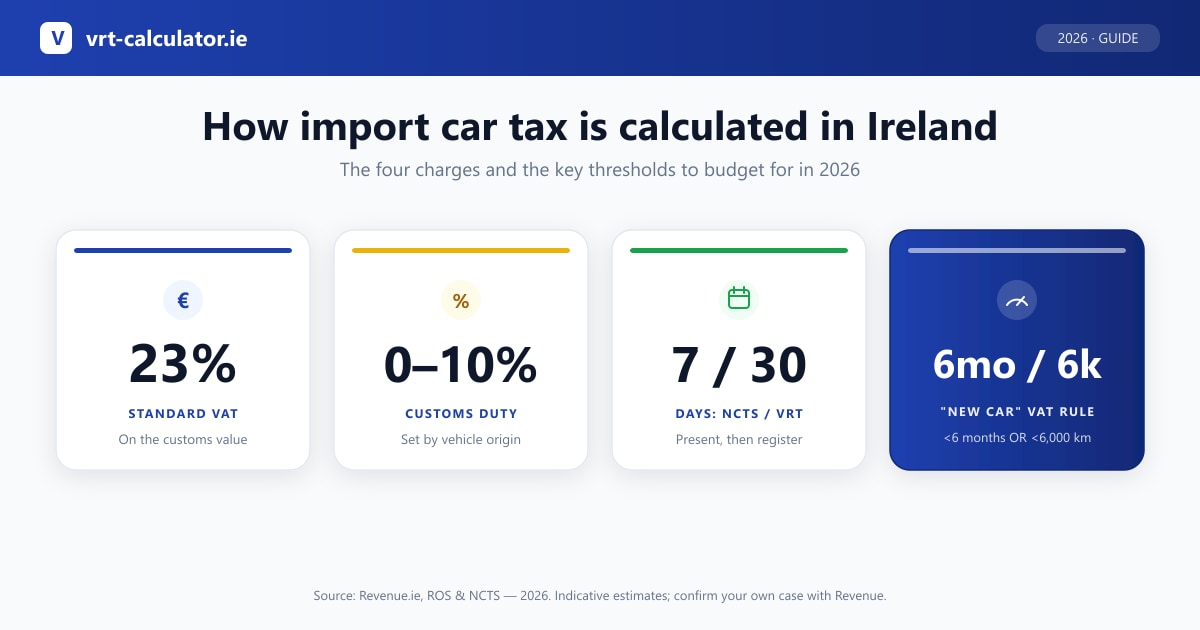
Importing a car to Ireland can involve four separate charges: customs duty, VAT at 23%, Vehicle Registration Tax (VRT) and, for most petrol and diesel cars, a NOx levy. All of them are collected by the Revenue Commissioners, but at two different moments — duty and VAT are settled at import through a customs declaration, while VRT and the NOx levy are charged when you register the car at an NCTS centre.
Here is what each charge covers:
- Customs duty — a tariff on bringing the car into the EU, due mainly on cars from Great Britain or outside the EU.
- VAT (Value Added Tax) — Ireland's standard 23% consumption tax, applied to the value of the imported vehicle.
- VRT (Vehicle Registration Tax) — the tax for putting the car on Irish plates; if you are new to it, start with what VRT actually is.
- NOx levy — an emissions charge added to VRT for most petrol and diesel cars.
Customs duty: when it's 0% and when it's 10%
Customs duty on a car imported to Ireland is 0% when the vehicle meets the UK–EU rules of preferential origin, and 10% when it does not. The first charge to settle is duty, because it feeds into the value the other taxes are calculated on.
Since Brexit, a car from Great Britain is treated as a non-EU import, and the trap is that origin is not the same as where you bought the car. Origin means where the vehicle was manufactured under the rules of preferential origin — not its last registration country. A UK-built car imported from Great Britain can qualify for 0% duty when proof of origin is provided; a German- or Japanese-built car sold in Great Britain usually does not, so it lands the standard 10%.
For any Great Britain import you must lodge a customs declaration before the car is presented for registration, filed through Revenue's AIS system on ROS (Revenue Online Service), which requires an EORI number. (Source: Revenue.ie, vrt.ie, 2026.)
VAT at 23%: what it's actually charged on
VAT on an imported car in Ireland is charged at the standard rate of 23% on the customs value — the purchase price plus transport, insurance and any customs duty already added. Once duty is known, it rolls into this base, which is exactly why the order of the calculation matters: VAT is charged on the duty too, not just on the car.
One rule catches many buyers off guard. A vehicle counts as a "new means of transport" if, at import, it is less than 6 months old OR has travelled less than 6,000 km. If either is true, VAT is due even on a "used" car — including some Northern Ireland purchases — regardless of whether VAT was already paid abroad. (Source: Revenue.ie, ncts.ie, 2026.)
VRT: OMSP, CO₂ band and the NOx levy
VRT is a percentage of the car's Open Market Selling Price (OMSP) set by Revenue, based on its CO₂ emissions, with a separate NOx levy added for most petrol and diesel cars. Customs duty and VAT cover bringing the car into the country; VRT is the charge for registering it on Irish plates.
The key point is that OMSP is Revenue's view of the Irish market value — not the price you paid abroad. Revenue calculates it from the vehicle data passed on by the NCTS centre after your car is examined, then applies the VRT rate that matches its CO₂ band. You can read how Revenue sets the OMSP for the detail.
On top of VRT sits the NOx levy, charged separately on the car's nitrogen-oxide emissions (priced per mg/km), which can add anything from a modest sum to several thousand euro on a high-emitting diesel. See how the NOx levy is worked out for the bands. (Source: Revenue.ie, ros.ie, ncts.ie, 2026.)
Worked example: a full UK-to-Ireland import
Take a 2019 Volkswagen Golf 2.0 TDI bought for £14,000 in Great Britain (about €16,500). Because the Golf is built in Germany, it does not qualify for UK preferential origin, so the 10% customs duty applies — and a realistic all-in import bill adds roughly €9,000–€10,000 once customs duty, VAT, VRT and the NOx levy are included. Putting the four charges together is where the real number appears — so here is the calculation from purchase price to final cost.
| Step | Amount |
|---|---|
| Purchase price — VW Golf 2.0 TDI (£14,000) | €16,500 |
| Transport + insurance | €600 |
| Customs value | €17,100 |
| Customs duty (10%, non-UK origin) | €1,710 |
| VAT at 23% on (€17,100 + €1,710) | ~€4,326 |
| VRT (OMSP, mid CO₂ band) | ~€2,500 |
| NOx levy | ~€300 |
| Estimated import taxes | ~€9,400 |
| Delivered total | ~€25,900 |
Swap to a UK-built car — say a Sunderland-built Nissan Qashqai — with valid proof of origin, and the €1,710 duty disappears, with the VAT charged on it dropping too. That is why origin is the single biggest lever on your bill. For your own figures, an instant import cost estimate shows how much VRT typically lands at across CO₂ bands.
Import routes compared: GB, Northern Ireland, EU and non-EU
Your import route decides which taxes apply: a car from Great Britain can attract all four charges, a car bought in the EU usually has no customs duty, and Northern Ireland imports may avoid duty entirely under the Windsor Framework. The example above used a Great Britain import, but the totals shift a lot depending on where you buy.
| Route | Customs duty | VAT (23%) | VRT | NOx levy |
|---|---|---|---|---|
| Great Britain | 0% or 10% (by origin) | Usually yes | Yes | Yes |
| Northern Ireland | Usually none (Windsor Framework) | Possible ("new" car rule) | Yes | Yes |
| EU country | None | Only if "new means of transport" | Yes | Yes |
| Non-EU via GB | Usually 10% | Yes | Yes | Yes |
The headline for Northern Ireland is that duty is normally avoided when the Windsor Framework conditions are met — but VAT can still apply if the car is a "new means of transport." Whatever the route, VRT and the NOx levy are always due on registration. (Source: sttax.ie, Revenue.ie, 2026.)
Common mistakes that inflate your import tax bill
The most expensive import mistakes are missing the NCTS and VRT deadlines and assuming your purchase price is the VRT base — VRT is calculated on Revenue's OMSP, not on what you paid. Knowing the taxes is half the battle; avoiding the errors that trigger penalties or surprise charges is the other half.
- Missing the deadlines: present the car at an NCTS centre within 7 days of arrival and complete VRT within 30 days — late registration risks penalties.
- Skipping the customs declaration on a Great Britain import (no EORI, no AIS filing) stalls the whole process.
- Budgeting on the invoice price instead of the OMSP, so the VRT estimate comes up short.
- Ignoring the 6-month / 6,000 km rule, then being surprised by VAT on a "used" car.
- Getting origin wrong, turning an expected 0% duty into a 10% bill.
Frequently asked questions
Import car tax in Ireland varies by where you buy the car, its age and its emissions — these are the questions buyers ask most before committing.
Do I pay VAT on a used car imported from the EU?
Usually no. If the car is genuinely used (over 6 months old and over 6,000 km) and VAT was already paid in the EU country, no further Irish VAT is due — but VRT still applies.
Do electric cars pay import tax in Ireland?
Yes, but less. Electric vehicles pay no NOx levy and sit in the lowest CO₂ bands, so VRT is low, while VAT and any duty still follow the import route.
Can I get an import tax estimate before I buy the car?
Yes. You can estimate VRT, VAT, duty and the NOx levy from the vehicle's details before purchase, which is the best way to check a deal still makes sense.
What exchange rate is used to convert a UK purchase price?
The sterling price is converted to euro using Revenue's published monthly customs exchange rate, not the rate on the day you paid — so your customs value can differ slightly from your bank's conversion.
Is import tax different for a car from Northern Ireland?
Often, yes. Customs duty is usually avoided under the Windsor Framework, but VAT can still apply if the car qualifies as a "new means of transport."
Published 17 June 2026 by the VRT Calculator Ireland VRT and import team. Verified against Revenue.ie, ROS and NCTS published rules.