A VRT exemption means you register a vehicle in Ireland without paying Vehicle Registration Tax, and Revenue only grants it in a short list of situations set out in the Finance Act 1992. For private drivers, the main VRT exemptions in Ireland cover moving your residence to Ireland with your own car, buying an adapted vehicle under the Disabled Drivers and Disabled Passengers Scheme, holding diplomatic or EU status, and inheriting a car from someone who died abroad. Non-residents can also drive a foreign-registered car here for a while without registering it, and owners who export an Irish car can recover part of the tax.
None of these reliefs is automatic: you apply to Revenue, prove each condition with documents and meet strict deadlines.
What counts as a VRT exemption in Ireland?
Revenue distinguishes permanent reliefs (no VRT, or VRT repaid, when you register) from temporary exemptions (no need to register at all for a limited period). Before looking at each case, it helps to know what Revenue actually means by an exemption, because some schemes called "exempt" only reduce the bill.
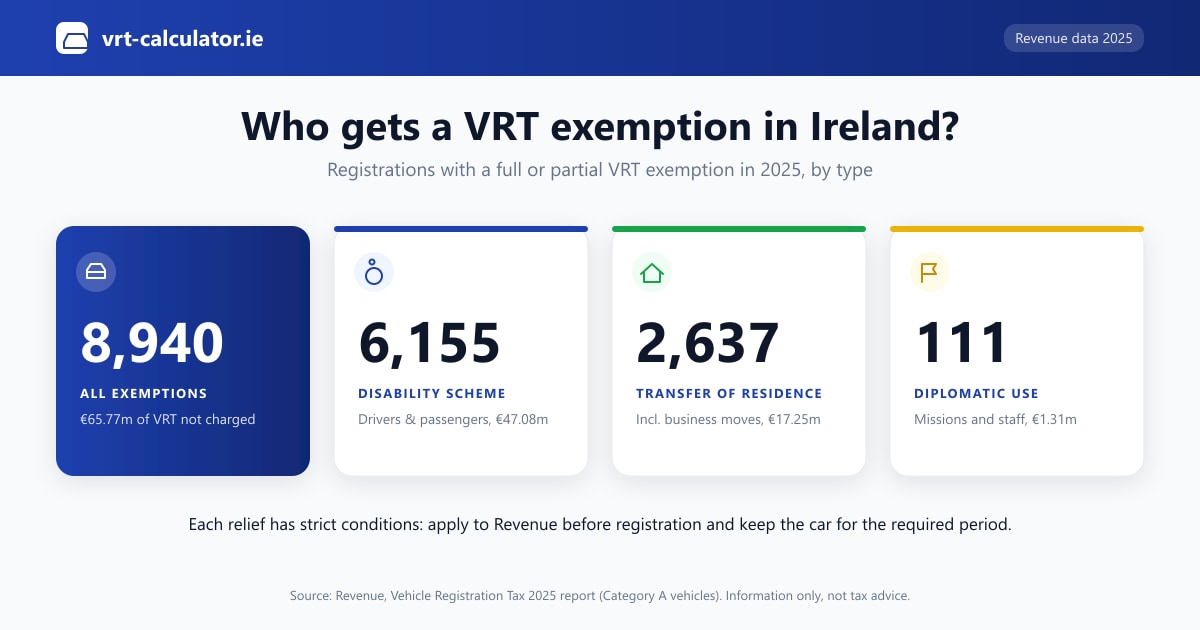
The VRT exemption Ireland grants most often is linked to disability. According to Revenue's Vehicle Registration Tax 2025 report, 8,940 registrations benefited from a full or partial exemption in 2025, worth €65.77 million:
- Disabled Passenger and Driver: 6,155 registrations, €47.08 million
- Transfer of Residence / Business: 2,637 registrations, €17.25 million
- Diplomatic use: 111 registrations, €1.31 million
- Other: 37 registrations, €0.13 million
Two situations need no claim at all. Category D vehicles (ambulances, fire engines, refuse carts, road rollers, sweeping machines) are charged at a nil rate. Electric cars get a relief of up to €5,000 when the Open Market Selling Price (OMSP) is €40,000 or less, reduced up to €50,000 and nil above, until 31 December 2026, and series production electric motorcycles are exempt until that date (revenue.ie, published 9 July 2026). Both are applied at registration; see our guide to VRT on electric cars. To know what you would pay without any relief, read how VRT is normally calculated.
Transfer of residence relief: moving to Ireland with your car
Transfer of residence VRT relief removes the tax on a car you bring with you when you move your normal residence to Ireland permanently, provided you owned and used it abroad for at least six months. It is the most common exemption for private drivers, and the one most often refused for missing evidence.
Who qualifies for transfer of residence relief?
Revenue's VRT Manual Part 2 (reviewed August 2025) and its transfer of residence page (published 9 July 2026) set the test. You must:
- have had your normal residence outside the State, meaning where you usually live for at least 185 days a calendar year;
- move to Ireland permanently and own the vehicle at the time of the move;
- have had possession and use of the car outside the State for at least 6 months before the move (use in Ireland never counts);
- bring it in within 12 months of the move, with local taxes paid and not refunded, and no commercial purpose.
Excluded are students returning after studying abroad, people abroad for a task of less than one year, and anyone who got the relief in the previous five years after a posting of one year or more.
In extenuating circumstances you could not foresee when buying the car (unexpected job offer, job loss abroad, ill health, bereavement, a crashed or stolen car), a Principal Officer can accept a minimum of 3 months' ownership.
Documents Revenue expects to see
The burden of proof is on you, with originals (Revenue copies and returns them). Proof that you lived abroad and moved can be property sale or purchase papers, foreign income tax or social benefit records, the end of a job abroad or an offer here, and utility bills or bank statements. Proof of ownership and use includes:
- the foreign registration document and insurance certificates;
- servicing and fuel receipts;
- shipping or ferry documents.
How to apply and the 7 and 30 day deadlines
The procedure is short but strict on timing:
- Send Form VRT TOR and your documents to the National VRT Service through MyEnquiries (category "TOR and Temp Exemptions Applic") or by post to Anne Street, Wexford, Y35 E29K, within 7 days of the car arriving.
- Book the NCTS pre-registration appointment within the same 7 days and enclose the confirmation.
- Receive the decision letter with its Exemption Identification Number (Revenue aims to decide within 10 working days).
- Register the car within 30 days of arrival, letter in hand.
A car arriving unaccompanied from outside the EU, including Great Britain since 1 January 2021, is claimed on Form C&E 1076 at customs instead; our guide to importing a car from the UK covers that route. After registration, the car cannot be sold, lent or hired out for 12 months unless you pay the relieved VRT or get Revenue's permission.
Disabled Drivers and Disabled Passengers Scheme
The Disabled Drivers and Disabled Passengers Scheme (now "Drivers and Passengers with Disabilities"), often searched as the disabled drivers scheme VRT relief, repays or remits VRT and VAT on an adapted vehicle, up to a cap of €10,000 to €48,000 depending on the adaptations. Moving house is not the only route to paying no VRT, and this scheme is open whether the vehicle is new, imported or already registered here.
Who can apply and the Primary Medical Certificate
Applicants can be a driver or passenger with a disability, one family member living with the passenger and responsible for their transport, or a registered charity. Everyone needs a Primary Medical Certificate from the Senior Area Medical Officer of the local HSE office, confirming a severe and permanent disability in one of six categories, such as being wholly or almost wholly without the use of both legs.
The vehicle must be specially adapted (automatic transmission alone does not count), bought rather than leased, registered in your name and under 6,000cc. Only one vehicle per person can be in the scheme at a time.
Maximum relief and how long you must keep the vehicle
Caps and holding periods come from Revenue's leaflet VRT7 (revised March 2026):
| Applicant | Adaptations | Specific adaptations | Extensive adaptations | Wheelchair accessible vehicle |
|---|---|---|---|---|
| Driver | €10,000 | €16,000 | €22,000 | €48,000 |
| Passenger or family member | €16,000 | n/a | €22,000 | €32,000 |
| Minimum holding period | 2 years | 3 years | 6 years | 6 years |
Selling, scrapping, giving away or hiring out the vehicle earlier, even after an accident, means refunding all or part of the relief.
Applying online, motor tax and fuel grant
Claims go through myAccount or ROS, or on paper to the Central Repayments Office in Limerick. For an import, upload the Vehicle Import Receipt from the NCTS centre and the paid adaptation invoice. The vehicle is then exempt from motor tax, and a fuel grant covers up to 2,730 litres a year (petrol at €0.706 per litre).
Diplomats, EU officials and international organisations
Diplomatic agents, consular officers, missions and their administrative and technical staff can register vehicles without VRT, with the number capped by status. Some exemptions depend not on your health or address but on your official position:
- diplomatic agent posted alone: one vehicle;
- diplomatic agent with spouse or family: two vehicles;
- administrative and technical staff (non-nationals, vehicle acquired within 6 months of taking up duty): one vehicle;
- diplomatic mission: one vehicle in normal circumstances.
Honorary consuls are excluded. The Form Dip 2 application is certified by the Department of Foreign Affairs and Trade before arrival. EU officials taking up a post here can claim for up to two vehicles brought in or bought within 12 months, and EU institutions for one. In both cases, selling within 2 years makes the residual tax payable. Irish officials returning from diplomatic or UN service with a tax-free car need 12 months of possession abroad rather than six (VRT Manual Part 2).
Inheritance, business transfers and other permanent reliefs
A car inherited from someone who died abroad can be registered without VRT if you acquired it directly under the will or intestacy rules and bring it in within two years. Beyond status, Revenue covers a few life and business events.
You must be resident in the State (or be the personal representative), and the car must have been the deceased's personal property. Send the will and grant of probate, or a notary's declaration if there was no will, with the death certificate and foreign registration certificate. There is no resale restriction.
Other permanent reliefs include:
- transfer of a business undertaking moving entirely to Ireland, for vehicles used in its activity for 12 months (company cars excluded), with a 12 month resale restriction;
- donations from official bodies abroad, approved in advance;
- international air services vehicles (Form VRT 39).
Most of these claims use Form C&E 1081 or VRT36 (revenue.ie, Other permanent reliefs, published 9 July 2026).
Temporary exemption for foreign-registered vehicles
Under the VRT temporary exemption, if you are established outside Ireland, your foreign-registered car can be used here without Irish registration for up to 12 months, with no application needed. All the cases above end with an Irish registration; a temporary exemption avoids it altogether.
The car must stay taxed and registered abroad, must not change hands, be rented out or be loaned to anyone established here, and cannot carry passengers for reward. Beyond 12 months you must apply, except for:
- students studying in Ireland, for the length of their course;
- cross-border commuters driving between a foreign home and work here.
Irish residents employed by an employer in another EU Member State or Northern Ireland that provides the car, or self-employed with a business mainly carried on there, can also qualify. Rallies, exhibitions and demonstrations have their own temporary exemptions (revenue.ie, Temporary exemption, published 9 July 2026).
Getting VRT back: the export repayment scheme
Under the VRT export repayment scheme, when you export an Irish-registered car, Revenue repays the residual VRT, minus a €100 administration fee, if the vehicle is worth at least €2,000. Exemptions apply on the way in; on the way out, a repayment can apply instead (revenue.ie, published 18 August 2025):
- The car was taxed at the Category A rate, is registered and VRT paid, with a valid NCT.
- It passes an export examination at an NCTS centre, with an OMSP of €2,000 or more.
- It leaves the State within 30 days of that examination.
- You claim with proof of removal and the new EU registration number.
The repayment never exceeds the VRT originally paid.
Every VRT exemption at a glance, and the mistakes that cost you the relief
Most refused claims fail on paperwork or timing rather than eligibility, so check the key condition and resale rule for your case before shipping the car. To pull the cases together:
| Case | Key condition | Claim form | Resale restriction |
|---|---|---|---|
| Transfer of residence | 6 months' use abroad | VRT TOR (C&E 1076 at customs) | 12 months |
| Disability scheme | Primary Medical Certificate, adapted vehicle | myAccount or ROS | 2 to 6 years |
| Diplomats and missions | Status certified by Foreign Affairs | Dip 2 | 2 years |
| EU officials | Post taken up in Ireland | VRT36 or C&E 1081 | 2 years |
| Inheritance | Direct heir, import within 2 years | C&E 1081 or VRT36 | None |
| Temporary use | Established outside the State | None up to 12 months | Cannot sell or lend here |
The errors that come up most often:
- sending photocopies when Revenue asks for original documents;
- letting the registration deadline pass, which leaves the car liable to detention or seizure;
- turning up at the NCTS without the exemption letter;
- selling the car before the restriction ends.
If documents are missing, Revenue refuses rather than waits; you register and pay, and the VRT is refunded once the relief is granted. Book your NCTS appointment as soon as the car lands, and if you do not qualify, estimate the bill with our VRT calculator before deciding to import.
FAQ
Can I bring more than one car under transfer of residence?
Yes. Revenue sets no limit on the number of vehicles relieved on one transfer of residence, as long as each car meets every condition on its own (VRT Manual Part 2).
How old does a car need to be for cheap VRT?
A vehicle more than 30 years old at the time of registration falls into VRT Category C and is charged a flat €200, whatever its value or emissions (revenue.ie, Calculating VRT, published 21 July 2026). It is a reduced rate rather than an exemption, so no claim is needed.
Can I appeal if Revenue refuses my claim?
Yes, but only after paying the VRT and registering the car. If the appeal succeeds the VRT is refunded; if it fails, taking the car out of Ireland does not bring the money back.
Published 1 October 2026 by the VRT Calculator Ireland editorial team.